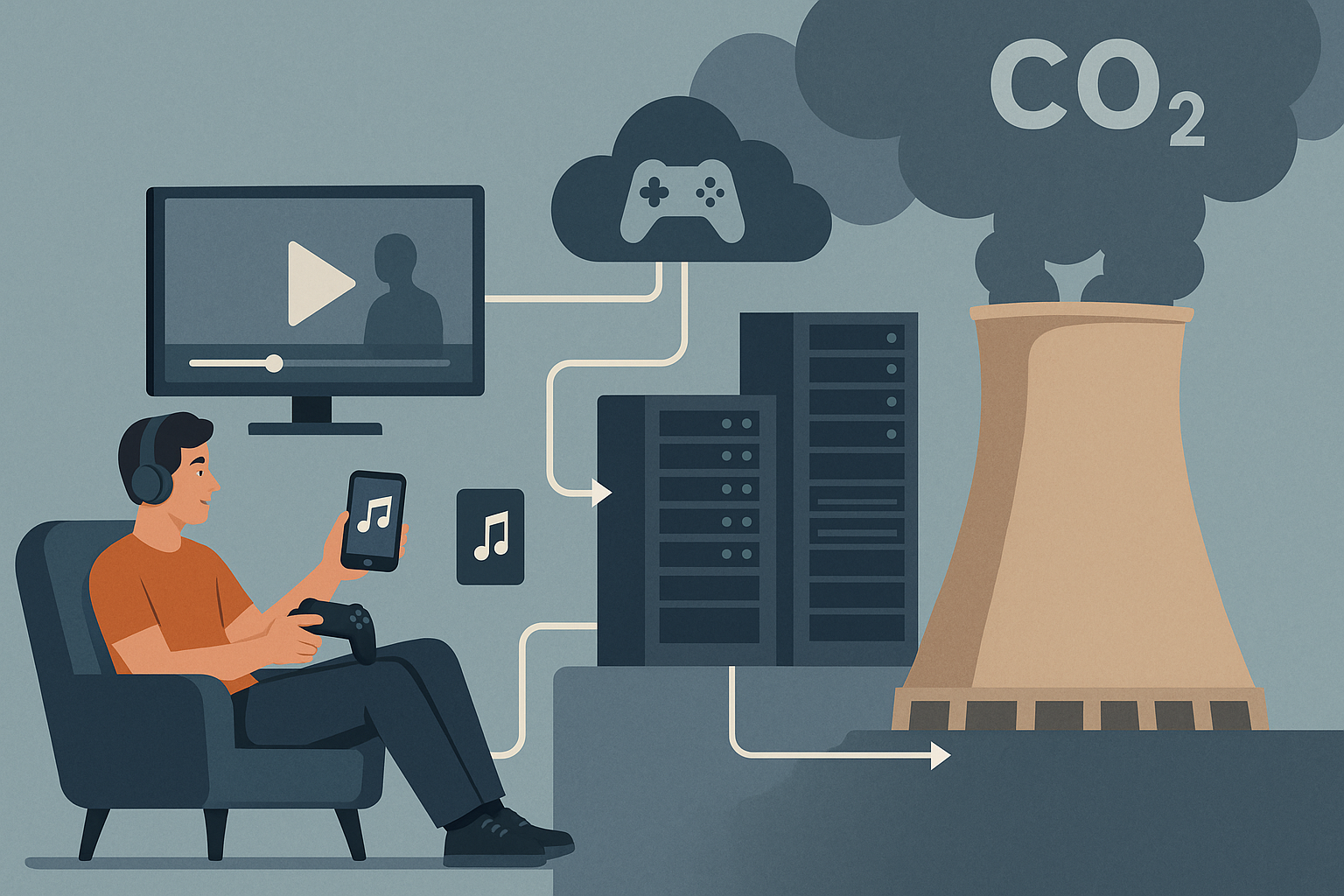
Digital entertainment from binge-watching high-resolution video to cloud gaming and endless playlists feels weightless. Yet every play, download or sync requires physical infrastructure, electricity and data movement. This case study examines the pathways through which streaming video, music and gaming create carbon emissions, highlights where the greatest opportunities for reduction lie, and offers actionable strategies for platform operators, developers and everyday users.
How digital plays translate into carbon emissions
When someone presses play, a chain of energy-consuming events begins. Content stored in servers is retrieved, packaged and transmitted across networks, routed through content delivery networks (CDNs) and local internet exchanges, and finally decoded and rendered on a device. Emissions arise from the electricity used by data centers, the networking equipment that carries the bits, and the end-user devices energy consumption. The carbon intensity of the electricity powering each link determines the greenhouse gas impact.
Key emission drivers in streaming and gaming
There are three principal drivers that shape the climate footprint of digital entertainment. First, data volume: higher-resolution video and richer game assets require more bits, which in turn demand more energy to store, transmit and process. Second, delivery architecture: longer transmission distances, inefficient routing and lack of edge caching increase network load. Third, device and software efficiency: poorly optimized clients and high-power hardware increase consumption at playback or during gameplay.
Video streams at ultra-high definition and higher frame rates can multiply data throughput compared with standard definition. Cloud gaming pushes the envelope further: server-side rendering and constant uplink/downlink interaction create continuous energy demand both in datacenters and on network paths. Music streaming, while lighter per stream than video, becomes significant when multiplied by billions of plays and by background playback patterns on always-on devices.
Where reductions matter most
Analyzing the supply chain reveals where interventions yield the biggest returns. For long-haul transmission, improving CDN placement and reducing redundant cross-border routing lowers network energy. Within data centers, migrating to lower-carbon electricity and modernizing server utilization are powerful levers. On devices, optimizing codecs, reducing unnecessary background streaming and implementing power-aware playback reduce end-user energy draw.
Not all interventions have equal cost or user impact. Shifting a providers energy mix to renewables or procuring guarantees of origin decreases operational emissions without changing the user interface. Conversely, asking users to downgrade resolution might save more energy per session but risks degrading the user experience unless communicated well and offered as a smart default.
Operational tactics for platforms and studios
Platform operators can blend technical improvements with procurement and design choices to reduce emissions. Employing modern, efficient video codecs reduces bitrates for a given visual quality; techniques such as variable bitrate and adaptive streaming ensure that the delivered quality matches network and device capabilities rather than defaulting to the highest profile every time. Edge caching and intelligent prefetching position popular content closer to users, cutting long-haul network load.
For cloud gaming providers, server consolidation and regional edge rendering reduce both compute and network footprints. Game developers can tune assets, offer scalable graphical settings, and design for sustained play at lower frame rates where feasible. Background audio and wallpaper playback should default to energy-conserving modes on mobile apps, and apps should gracefully suspend or reduce data usage when devices enter low-power states.
Procurement of renewable electricity or contracts that match consumption with low-carbon sources has immediate benefits. Where direct clean energy procurement is not feasible, investing in local renewable projects or working with cloud and hosting providers that prioritize carbon-free energy can materially lower the emissions associated with content delivery and processing.
Design and product decisions that cut emissions without harming engagement
Good product design reduces wasteful consumption. Implementing smarter defaults like standarding to high-definition rather than ultra-high-definition on mobile, or pausing background playback when headphones are disconnected protects the user experience while trimming unnecessary data flow. Informative nudges can increase user awareness: showing an option to stream in a lower resolution for reduced environmental impact or offering a data-saver mode for playlists are simple features that many users respond positively to.
For subscription platforms, bundling eco-friendly options into account settings and rewarding users who choose lower-impact options with app badges or perks taps into intrinsic motivations. For competitive gaming, enabling frame-rate caps, providing performance presets and optimizing network code to minimize retransmissions can lower energy use on both client and server sides.
Measurement and transparency
Sustainable decision-making starts with reliable measurement. Platforms should track energy consumption across their infrastructure and estimate the share attributable to content delivery. That requires instrumenting data centers, logging key network metrics and understanding device-side energy use patterns. While precise per-stream carbon figures can be complex to isolate, trend-level reporting and scenario-based estimates enable meaningful targets and progress tracking.
Transparency builds trust: publishing methodologies, disclosing the energy mix of hosting regions and reporting progress toward emission reduction goals are practical steps. Where precise accounting is challenging, platforms can publish conservative ranges and explain the assumptions behind them. This openness reduces skepticism and helps users and partners make informed choices.
Consumer-level actions that scale
Individual habits matter because billions of interactions add up. Choosing lower playback resolutions when high fidelity is unnecessary, turning off autoplay, downloading playlists for offline listening instead of repeated streaming, and limiting background streaming on mobile all lower personal impact. In gaming, selecting energy-saving console modes, capping frame rates, and closing unneeded background apps reduce device draw during play sessions.
Users can also influence platforms through collective demand for greener options. Prioritizing services that publish sustainability commitments or selecting apps with power-saving features nudges the market toward low-impact design. Small behavioral changes repeated at scale create meaningful reductions.
Policy, industry collaboration and standards
Regulation and sector-wide standards accelerate change. Shared measurement frameworks for digital emissions, common reporting formats, and incentives for energy-efficient content delivery encourage consistent action across providers. Collaboration between network operators, cloud providers, device manufacturers and content creators ensures that optimizations are effective end-to-end rather than shifting burdens between actors.
Standards bodies and industry groups can advance codec adoption, push for energy-aware networking protocols and promote certification schemes for low-impact services. Public procurement policies that prefer providers demonstrating measurable reductions can also create market pull for sustainable practices.
Practical next steps for companies and creators
Start by mapping where content-related energy is consumed across your stack and prioritize quick wins: enable efficient codecs, improve caching, and set sensible defaults that favor energy saving. Engage with infrastructure partners about their energy sourcing and pursue cleaner electricity options. Measure changes, share methodologies publicly, and iterate. For creators, optimizing file sizes, choosing efficient production pipelines and being mindful of distribution formats can reduce lifecycle impacts without compromising creative intent.
Digital entertainment is not inherently unsustainable, but its scale means small inefficiencies become large emissions. By combining technical fixes, procurement choices, thoughtful user defaults and clear reporting, platforms and users can preserve the richness of modern media while substantially shrinking its climate footprint.