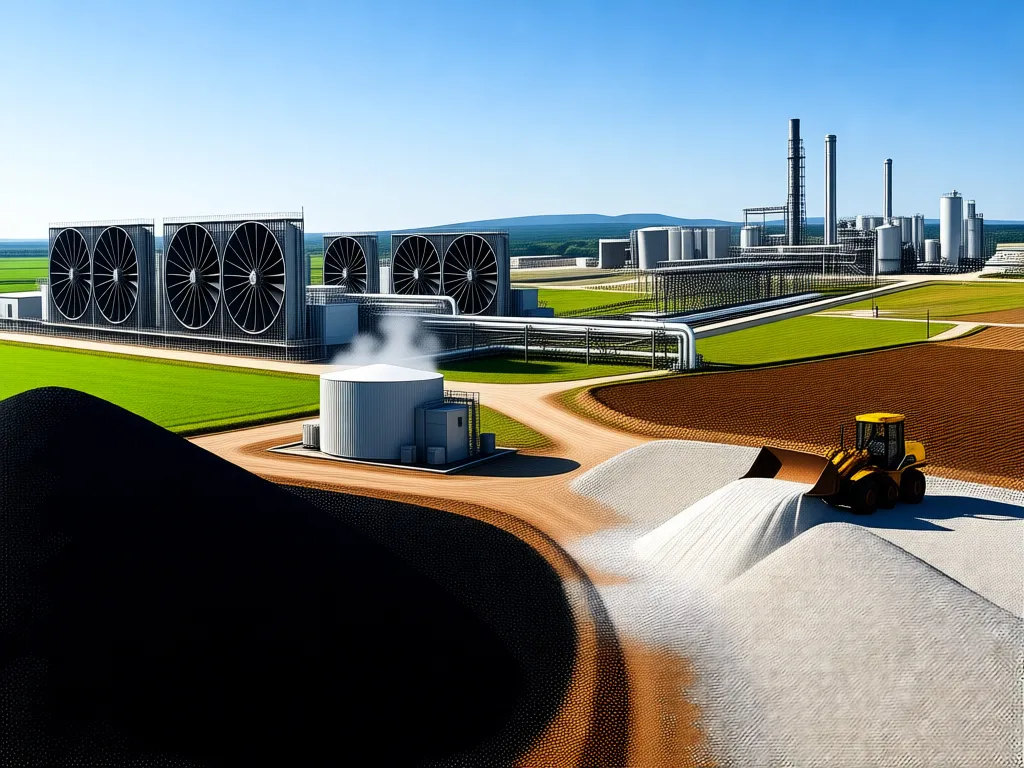
How these carbon removal approaches differ at a glance
Carbon removal means taking carbon dioxide out of the atmosphere and storing it in a way that keeps it out of the atmosphere for years to centuries or longer. Direct air capture, biochar and enhanced weathering use different physical and chemical processes, require different resources, and create different verification and deployment challenges. Understanding those contrasts is essential when choosing which approaches to prioritize.
What direct air capture does and how it works
Direct air capture captures carbon dioxide directly from ambient air using engineered chemical processes. Systems pass air over a sorbent or through a liquid solvent that selectively binds CO2. The captured CO2 is then released from the sorbent by applying heat, pressure change or a chemical step. Once concentrated, CO2 is either stored underground in geological formations or used in products that lock the gas away for a defined period.
Key operational features are the high dilution of CO2 in air and therefore the energy required to collect and concentrate gas, the need for a reliable energy supply, and the logistics of transport and permanent storage if geological sequestration is the chosen end point.
What biochar does and how it works
Biochar is a stable carbon-rich solid produced by heating biomass in a low-oxygen environment, a process known as pyrolysis. The process converts a fraction of plant carbon into a form that is more resistant to decomposition than the original biomass. When biochar is applied to soils or used in durable products, it can store carbon for years to centuries and can change soil properties in ways that affect plant growth, water retention and nutrient dynamics.
Biochar systems require a sustainable biomass feedstock, control of pyrolysis conditions to produce a stable product, and consideration of complementary uses for pyrolysis co-products such as bioenergy or bio-oil.
What enhanced weathering does and how it works
Enhanced weathering accelerates natural rock weathering reactions that remove CO2 from the atmosphere. Finely ground silicate or carbonate minerals are spread on land or in coastal environments where they chemically react with CO2, forming dissolved bicarbonate or solid carbonate minerals. Those reaction products are then transported and stored, including eventual deposition in sediments or the ocean.
Enhanced weathering depends on mining and grinding minerals, the surface area provided by the applied material, local climate and hydrology that affect reaction rates, and pathways for long-term storage of the reaction products.
Permanence, verification and monitoring considerations
Permanence
Permanence refers to how long carbon remains out of the atmosphere. Direct air capture paired with secure geological storage offers long-term permanence when CO2 is injected into suitable rock formations. Biochar permanence depends on feedstock, production temperature and soil conditions; well-produced biochar can persist for decades to centuries but decomposition risk exists. Enhanced weathering that forms stable carbonate minerals or transports bicarbonate to the ocean can achieve long-lived sequestration, although the timescale depends on local geochemistry and transport processes.
Verification and monitoring
Each method requires different monitoring approaches. Direct air capture facilities can measure amounts of CO2 captured and injected using facility metering and well monitoring. Biochar projects need protocols that document feedstock sourcing, pyrolysis conditions and field fate; soil measurements and modelling are used to estimate carbon retained. Enhanced weathering verification must track mineral application rates, dissolution and downstream chemistry; measuring the fate of dissolved carbonate and demonstrating net removal relative to baseline are central verification challenges.
Scalability and resource needs
Energy, land and material demands
Direct air capture is energy intensive because it treats large volumes of low-concentration air and therefore requires reliable supplies of low-carbon heat and electricity. Sites benefit from proximity to storage reservoirs to minimize transport. Biochar scales with availability of sustainable biomass residues and with suitable application lands if soil amendment is the chosen sink. Enhanced weathering requires access to mined rock and energy for grinding, plus transport and spreading capacity to distribute mineral fines at the scale needed.
Potential bottlenecks
Bottlenecks differ by approach. For direct air capture, availability of low-carbon energy and regional storage sites shapes deployment. For biochar, sustainable feedstock availability and feedstock competition with other biomass uses limit expansion. For enhanced weathering, mining capacity, grinding energy and nontrivial logistics for spreading mineral fines are primary constraints.
Co-benefits and risks to weigh
Co-benefits
Direct air capture paired with storage generates clear carbon removal but offers limited ecosystem co-benefits compared with nature-based options. Biochar can improve soil fertility, water retention and crop resilience when applied appropriately. Enhanced weathering can affect soil pH and nutrient availability and may provide co-benefits for soil health in some contexts; in marine applications it can counter ocean acidification locally.
Environmental and social risks
All methods carry risks that require proactive management. Direct air capture can create local emissions and land use impacts from new industrial facilities and energy infrastructure. Biochar projects can cause soil or water quality problems if produced or applied poorly and can compete with other uses for biomass; they also require governance to avoid incentivizing harmful land use change. Enhanced weathering involves mining impacts, dust and potential changes to soil and aquatic chemistry that must be assessed at site scale. Community consent, supply chain transparency and environmental safeguards matter for all deployments.
Costs and economic considerations
Cost structures vary. Direct air capture has capital and energy cost components and benefits from economies of scale and learning as projects deploy. Biochar economics depend on feedstock cost, pyrolysis capital, potential revenue for co-products and any payments for climate benefits. Enhanced weathering costs reflect mining and grinding energy, spreading logistics and monitoring. When assessing projects, include full lifecycle emissions, co-product values and the costs of long-term monitoring and liability management.
Decision criteria for selecting an approach
Choose criteria that match your objectives and constraints. If long-term, verifiable atmospheric removal with industrial control is the priority and low-carbon energy and storage are available, direct air capture may suit that objective. If improving soil properties while storing carbon at moderate permanence and using local biomass residues is feasible, biochar merits consideration. If mineral resources are accessible and geographical conditions favor rapid weathering, enhanced weathering can be evaluated.
Important criteria include permanence expectations, measurable verification pathways, local environmental impacts, supply chain sustainability, regulatory and permitting context, and cost per ton when calculated with transparent assumptions. Projects that internalize monitoring, reporting and liability plans reduce long-term uncertainty.
Practical steps for businesses and project developers
Start by defining a clear objective for carbon removal and the decision metrics you will use. Assess local resource availability including energy supply, biomass streams, mineral sources and potential storage sites. Engage independent technical reviewers early to design monitoring and verification plans that align with recognized standards. Factor in community engagement and environmental impact assessment before committing to large-scale operations. Where possible, pilot at a scale that generates verifiable data on permanence and co-effects before expanding.
Questions to ask potential vendors or partners
Request transparent lifecycle accounting that shows net atmospheric removal, not gross capture. Ask for monitoring and verification plans including measurement methods and how persistence of stored carbon will be assured. Verify feedstock sourcing rules for biochar and potential land use impacts. For enhanced weathering, inquire about mining, grinding energy, dust control and downstream monitoring of dissolved carbon. For direct air capture, confirm the source of energy used for capture and regeneration and documentation for permanent storage.
Policy and governance considerations
Effective deployment will rely on clear rules for measurement, reporting and verification and on frameworks that define permanence and liability. Policies that reward demonstrable net removal rather than unverified claims are essential. Public funding for pilot projects and infrastructure such as CO2 transport and storage can reduce early costs and help establish standards. Regulations should require environmental safeguards, community consultation and transparent accounting to avoid unintended consequences.
How to compare options in practice
When comparing options for a specific project, assemble comparable metrics: net atmospheric removal per unit input, expected duration of storage, full lifecycle emissions, land and water footprint, cost including monitoring and liability, and local environmental and social impacts. Use independent technical review and, where available, standardized protocols or recognized certification schemes to ensure apples-to-apples comparison.
Where the evidence is strongest and where uncertainty remains
Engineering-controlled methods with measurement at facility scale tend to provide clearer short-term measurability. Long-term risks such as permanence in soils or ocean chemistry effects require ongoing study. Research continues on improving energy efficiency for direct air capture, enhancing biochar stability in diverse soils, and accelerating weathering reactions at realistic scales with acceptable environmental impacts. Until monitoring data grow, conservative accounting and robust safeguards remain prudent.
Readers deciding between approaches should prioritize approaches with transparent verification, manageable local impacts, and alignment with broader climate and land-use objectives. Combining different removal strategies in a portfolio can balance trade offs across permanence, co-benefits and scalability.