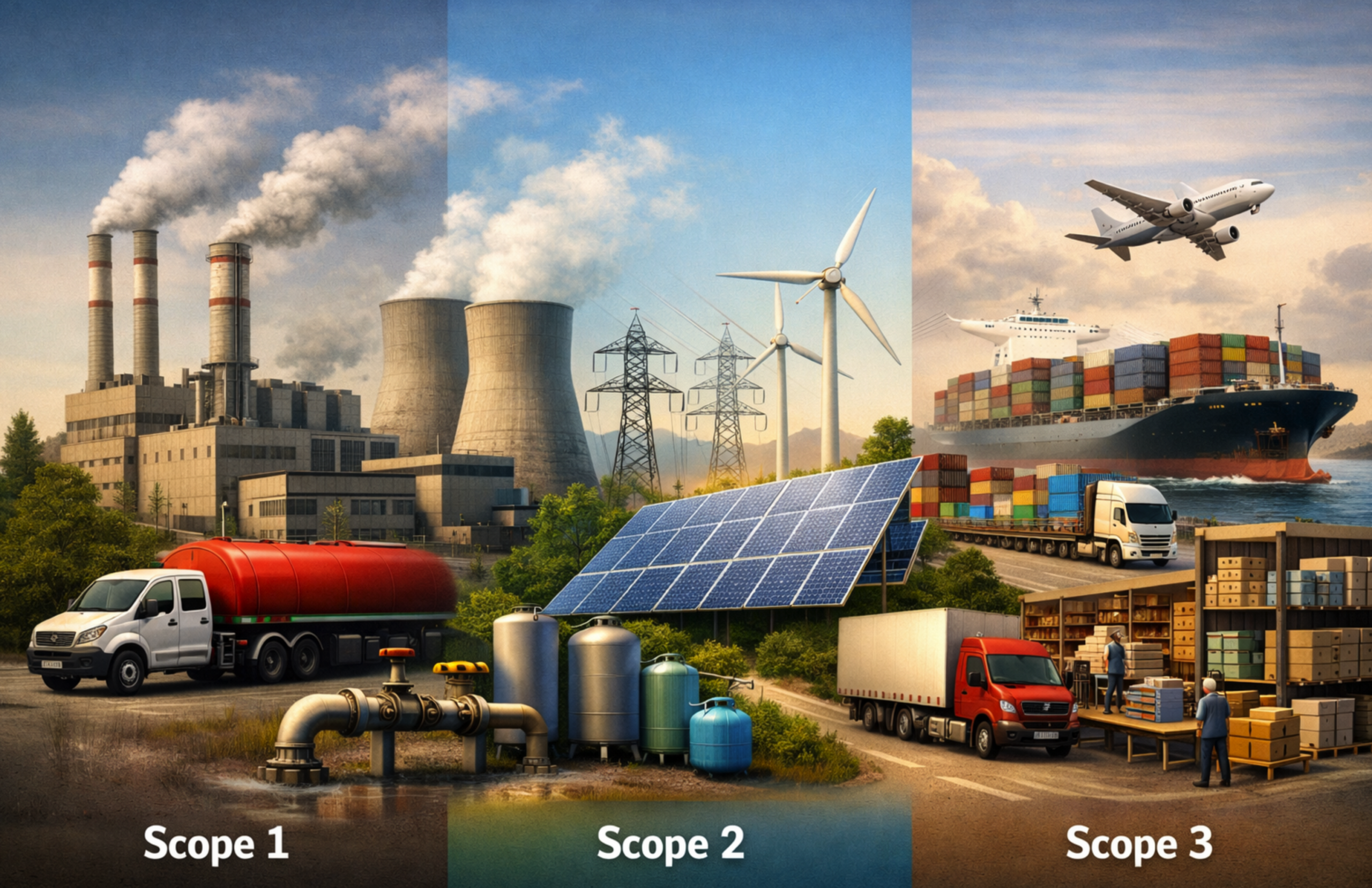
Most companies that take climate action confront one question early on: which emissions count and how should they be managed? The answer sits in a widely used three-part framework that separates emissions into direct sources, purchased energy, and the broader value chain. Grasping these categories helps organisations prioritize efforts, design credible reductions, and meet investor and regulatory expectations.
What each scope represents
Scope 1 covers direct greenhouse gas releases from sources that a company owns or controls. Typical examples include fuel burned on-site for boilers, emissions from company-owned vehicles, and fugitive releases such as refrigerant leaks. Because these emissions arise inside the organisation’s operational boundary, they are generally the easiest to identify and attribute.
Scope 2 captures indirect emissions from the generation of bought electricity, heat, steam, or cooling consumed by the reporting entity. The greenhouse gases are produced by a third party, such as a power plant, but they are linked to the company because the business uses the resulting energy. Many organisations focus on this category because switching to renewable electricity can produce rapid and verifiable reductions.
Scope 3 includes all other indirect emissions that occur in a company’s value chain, both upstream and downstream. This group is the broadest and can cover emissions associated with purchased goods and services, business travel, employee commuting, transportation and distribution, use of sold products, end-of-life treatment of sold products, and investments, among others. Scope 3 often represents the largest share of a companys footprint, especially for service providers and manufacturers with extensive supply chains.
Why the distinctions matter
Separating emissions into three categories is not an academic exercise. It shapes where a company focuses time, budget, and policy. Direct control versus influence matters for both strategy and accountability. If a large portion of a companys emissions lies in Scope 3, focusing only on operational measures will miss the bulk of its impact. Conversely, identifying sizeable Scope 1 sources signals opportunities for on-site efficiency and fuel switching that can be measured and reported with high confidence.
Different stakeholders also treat the scopes differently. Investors and customers often want transparency across all scopes because that reveals exposure to supply-chain risks and opportunities for deeper decarbonization. Regulators and standard-setters are increasingly requiring disclosure that spans beyond the factory floor to include value chain impacts.
How to measure each scope reliably
Measurement approaches vary by scope and by how granular an organisation wants to be. For Scope 1, companies typically rely on fuel purchase records, equipment specifications, metered data, and established emission factors to convert activity into carbon equivalents. Scope 2 measurement has two commonly accepted approaches: location-based, which uses the grid average emission intensity where the consumption occurs, and market-based, which accounts for contractual instruments such as renewable energy certificates or power purchase agreements.
Scope 3 is more complex because it often requires gathering data from suppliers, logistics partners, and customers. Companies can use supplier questionnaires, spend-based modelling, life cycle assessment databases, and industry-specific emission factors. A practical starting point is to map the value chain, identify the largest likely sources of emissions, and prioritize hotspots for more detailed data collection.
Common challenges and how to address them
One frequent obstacle is data availability. Suppliers may lack the systems to report activity-level data, forcing companies to rely on averages and proxies. To manage this, many businesses combine spend-based methods with targeted supplier engagement for high-impact categories. This hybrid approach balances accuracy and effort.
Another challenge is double counting. Because Scope 3 ties together multiple organisations, the same emissions can appear in more than one company’s inventory. Clear methodology documentation and consistent use of recognised standards help reduce confusion. The Greenhouse Gas Protocol provides widely accepted guidance for attribution and allocation.
Finally, organisations must be mindful of boundary setting. Deciding which entities, facilities, or product lines to include has material consequences for reported totals. Strong governance, defined policies, and transparent disclosures about scope and assumptions build credibility.
Practical reduction strategies by scope
For Scope 1, the most effective levers are process improvements, fuel switching, and equipment upgrades. Replacing fossil-fuel boilers with electric heat pumps, installing low-leak refrigerant systems, and electrifying vehicle fleets are examples that directly cut emissions. These interventions tend to be capital-intensive but can yield predictable reductions.
Scope 2 reductions are often achieved through clean energy procurement. Buying renewable electricity through power purchase agreements, investing in on-site generation like rooftop solar, or purchasing validated renewable energy certificates can significantly lower reported Scope 2 emissions. Energy efficiency measures also reduce consumption and therefore the associated indirect emissions.
Addressing Scope 3 requires working beyond the company’s four walls. Designing products for longevity, introducing take-back and recycling programs, selecting lower-carbon materials, and engaging suppliers to improve their energy mix are all impactful. Procurement policies that set sustainability criteria and long-term partnerships with key vendors can shift entire supply-chain footprints over time. For downstream emissions, redesigning products to be more energy efficient during use or offering services that reduce customer emissions are valid paths.
Reporting, targets, and verification
Setting a target that covers all three scopes sends a strong signal about ambition and risk management. Many companies now set science-based targets that require absolute or intensity reductions aligned with pathways to limit global warming. When targets include Scope 3, businesses must be transparent about the assumptions and the metrics they use to track progress.
Verification by a third party strengthens trust. Assurance providers check whether the inventory follows accepted standards and whether the data and methods are applied consistently. While verification adds cost, it can also reduce reputational and financial risk by making disclosures more robust.
Why investors and policymakers care
Investors use emissions data to assess transition risk and to identify companies that are prepared for tighter climate policy and changing market preferences. Emissions concentrated in a company’s supply chain can signal exposure to physical and regulatory risks that may not be visible from Scope 1 and 2 alone. Likewise, regulators in multiple jurisdictions are moving toward mandatory climate disclosures that include value-chain emissions, making comprehensive measurement a compliance issue as well as a strategic one.
Companies that disclose across all scopes are better positioned to find cost-effective reduction opportunities, anticipate regulatory shifts, and strengthen relationships with customers and investors who prize transparency.
Taking action begins with a clear inventory, followed by prioritized interventions and consistent disclosure. Whether the first step is fixing a refrigerant leak, signing a renewable power contract, or engaging a major supplier on materials sourcing, the three-part framework provides a roadmap for turning data into durable climate performance. Start by mapping your sources, choose pragmatic measurement methods, and align targets with the scale of your impact to move from intent to measurable results.