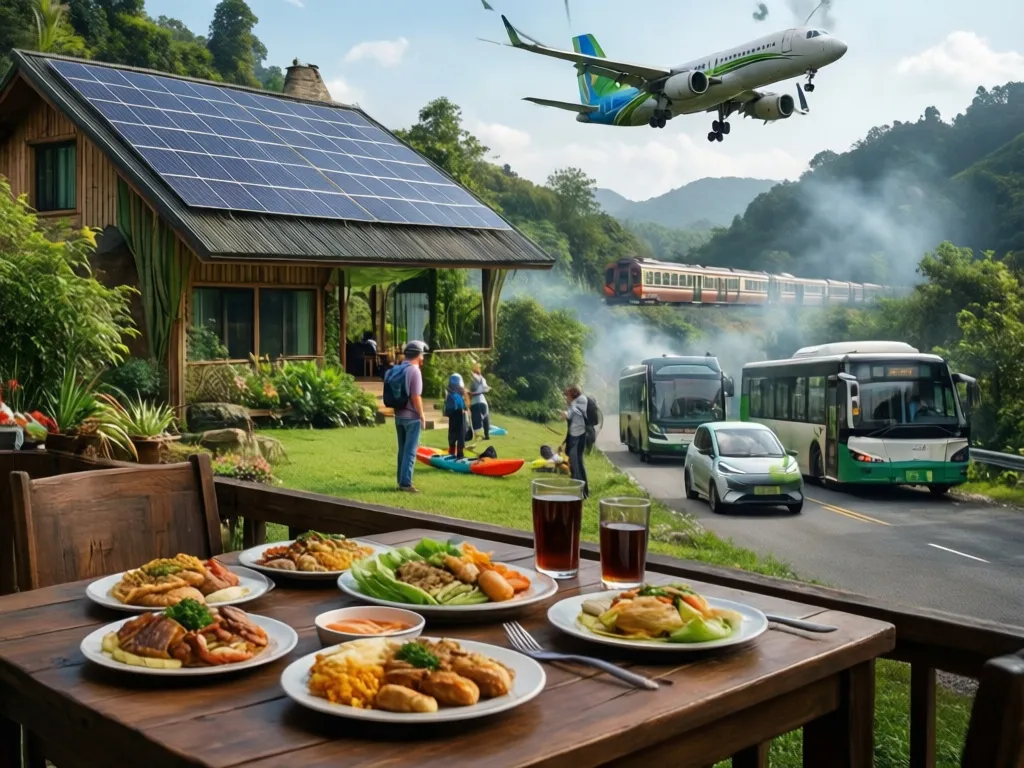
Tourism carbon footprints come from the whole trip
Tourism creates emissions across several stages of a journey. Transport can dominate the total in many trips, but accommodation, food, and activities also matter, especially when travel is longer, more resource intensive, or repeated often. If you only look at one part of the trip, you can miss the bigger picture.
The useful way to think about a tourism carbon footprint is to break it into the main services a traveler uses. That usually means transport to reach the destination, local transport after arrival, the place where you stay, the food you eat, and the activities you choose while you are there. Each of those has a different emissions profile and different ways to reduce impact.
Transport is often the largest part of the footprint
For many trips, especially longer ones, transport is the largest source of emissions. Air travel can be especially important because it uses a large amount of energy per passenger over long distances. But the size of transport emissions depends on the mode, the distance, how full the vehicle is, and how much of the trip is covered by private versus shared transport.
Rail, coach, and shared public transport usually have lower emissions per passenger than private cars or flights, although the exact difference varies by route and occupancy. For short trips, driving alone can become a major part of the footprint. For multi city itineraries, repeated airport transfers, rental cars, and local taxis can add up faster than many travelers expect.
When comparing transport choices, it helps to ask a simple question: what is the minimum amount of movement needed to make the trip work? That could mean choosing a destination reachable by train, staying longer in one place instead of taking several short flights, or using public transport once you arrive.
Accommodation affects emissions through energy, services, and occupancy
Hotels, resorts, guesthouses, and vacation rentals all use energy and materials, but not in the same way. Accommodation emissions are influenced by heating and cooling, hot water use, laundry, lighting, building design, food service, pool and spa operations, and how many guests are sharing the same space.
A larger room or higher service level does not automatically mean a higher footprint in every case, but more intensive facilities often require more energy and water per guest. A property with many amenities may also have a larger footprint because it runs more equipment and more service processes.
Occupancy matters too. A room or apartment used by one or two guests can have a different emissions intensity than the same space used near capacity. For that reason, a stay in a smaller, well used property is not always lower impact than a larger one, but lower service intensity and better energy management often help.
For travelers, useful questions include whether the property uses efficient heating and cooling, whether housekeeping is offered daily by default, whether the building design supports lower energy use, and whether the stay is long enough to make better use of the space and services already being operated.
Food choices can change the footprint of a trip in subtle ways
Food is easy to overlook because each meal seems small on its own. But over several days, restaurant meals, buffet service, imported ingredients, and high waste rates can become meaningful contributors to the total footprint. The climate impact of food depends on what is served, how it is produced, and how much is wasted.
Meals with a high share of animal products generally have higher emissions than meals centered on plant foods, though the exact difference depends on the ingredients and production methods. Food that needs energy intensive storage, air freight, or heated greenhouses can also carry a higher footprint. At the same time, local food is not automatically lower impact if it requires more energy to produce than alternatives from elsewhere.
Tourists also influence waste. Buffet breakfasts, oversized portions, and food bought but not eaten can raise emissions without adding any value to the trip. Choosing meals that are likely to be finished, avoiding unnecessary extras, and selecting simpler menus can reduce that waste.
For many travelers, the most practical food strategy is not strict avoidance but moderation. More plant rich meals, less food waste, and fewer energy intensive extras usually lower the footprint while still leaving room to enjoy local cuisine.
Activities can vary widely in emissions intensity
Activities are often treated as the fun part of tourism, but they can have very different environmental impacts. A walking tour, museum visit, or beach day usually has a lower direct footprint than motorized recreation, high energy attractions, or experiences that depend heavily on equipment, vehicles, or special facilities.
Some activities also drive indirect emissions through transport and infrastructure. A boat excursion, ski trip, golf course visit, or theme park day may involve energy use beyond what the traveler sees directly. The footprint depends on construction, maintenance, water use, energy demand, and the logistics needed to operate the attraction.
This does not mean every higher intensity activity should be avoided. It means travelers should understand that an activity is part of the carbon footprint, not separate from it. If reducing impact matters, the better question is whether the activity adds enough value to justify its resource use, and whether a lower intensity alternative would deliver a similar experience.
How the parts of the trip interact
A tourism carbon footprint is not just the sum of separate categories. The choices in one category can change the others. For example, taking a train instead of a flight may make a longer stay more practical, which can improve accommodation efficiency by spreading the fixed energy use of the stay over more nights in one place. Staying in one destination instead of moving between several can also reduce local transport and repeated check in and check out services.
Food and activities also interact with location. A remote resort may require more transport, more on site services, and more resource intensive food supply than a central hotel with easy access to public transport and nearby restaurants. A trip built around compact, walkable destinations can reduce several categories at once.
That is why single number comparisons can be misleading. Two trips with the same destination can have very different footprints if one uses direct transport, a simple stay, and mostly walking, while the other includes multiple transfers, a high service property, and energy intensive activities.
What travelers can do without turning the trip into an audit
Most travelers do not need a full life cycle assessment to make better decisions. They need a few reliable checks that improve choices without making travel exhausting to plan.
First, look at transport before anything else. If you can reduce distance, avoid unnecessary legs, or choose a lower emission mode, you often make the biggest cut quickly. Second, choose accommodation that fits the trip rather than the status expectation around the trip. A well located, efficient stay can reduce transport and service demand. Third, treat food as part of the footprint, which means avoiding waste and not assuming every premium or imported option is the best choice. Fourth, think about whether the activities need special transport or heavy infrastructure.
For business travel or recurring leisure travel, the same logic applies. Reducing trip count, combining purposes into one journey, and staying longer when possible can lower emissions more effectively than trying to optimize a single meal or hotel amenity in isolation.
How destinations and providers can reduce emissions
Tourism businesses and destination managers have influence too. Accommodation providers can improve building efficiency, reduce unnecessary laundry, manage heating and cooling better, and source energy more efficiently. Transport operators can improve occupancy, shift to lower carbon fuels where appropriate, and make it easier for travelers to choose shared or public options. Food providers can reduce waste, simplify menus, and source ingredients in ways that match local supply and seasonal availability. Activity operators can design experiences that use fewer resources while preserving quality.
Destinations can also shape behavior by making low impact choices easier. That includes good public transport, safe walking routes, bike access, clear information about emissions conscious options, and attractions that do not depend entirely on private cars or resource heavy infrastructure. When the lower impact option is also the easier one, more travelers will choose it.
What to watch out for when judging a low carbon travel claim
Travel providers increasingly use sustainability language, but not every claim is equally meaningful. A low carbon label for one service may only cover a narrow part of the footprint. A hotel might focus on linen reuse but ignore building energy. A tour operator might highlight electric vehicles while the trip still relies on long distance air travel. A restaurant might reduce packaging but waste a lot of food.
Useful questions are straightforward. What parts of the trip are covered by the claim? Is it about reduction or offsetting? Is the claim based on operational emissions only, or does it include the broader service chain? Is the lower impact option realistic for the type of traveler being served?
That kind of scrutiny helps avoid greenwashing and also prevents false expectations. A genuine improvement in one area can still leave a trip with a substantial footprint if the largest sources are untouched.
How to compare two trips fairly
If you need to compare travel options, compare them on the full journey rather than a single component. Start with transport distance and mode, then look at accommodation type and length of stay, then consider food and planned activities. If one option has a lower emission mode of transport but a much larger hotel footprint, the total may be less clear than it first appears. If one trip avoids flights but includes many local car journeys, the benefit may be smaller than expected.
The fairest comparison uses the same trip purpose, the same basic comfort level, and the same length of stay where possible. That makes it easier to see where the real differences come from. If you cannot control everything, focus on the largest and least flexible parts first. In most cases, those are transport and accommodation.
Tourism carbon footprints are complex because travel is a bundle of services, not one activity. But that complexity also makes improvement possible. Once you separate transport, accommodation, food, and activities, the biggest levers become much clearer, and the next trip becomes easier to plan with fewer tradeoffs hidden in the background.
Practical ways to lower the footprint of a trip
- Choose the lowest emission transport option that still makes the trip realistic.
- Stay longer in one place when that avoids extra travel legs.
- Pick accommodation that uses energy and water efficiently.
- Eat meals that are likely to be finished and reduce food waste.
- Favor activities that do not require heavy transport or resource intensive infrastructure.
The best choice is usually not the perfect choice. It is the one that cuts the largest sources first while still keeping the trip useful, enjoyable, and feasible.