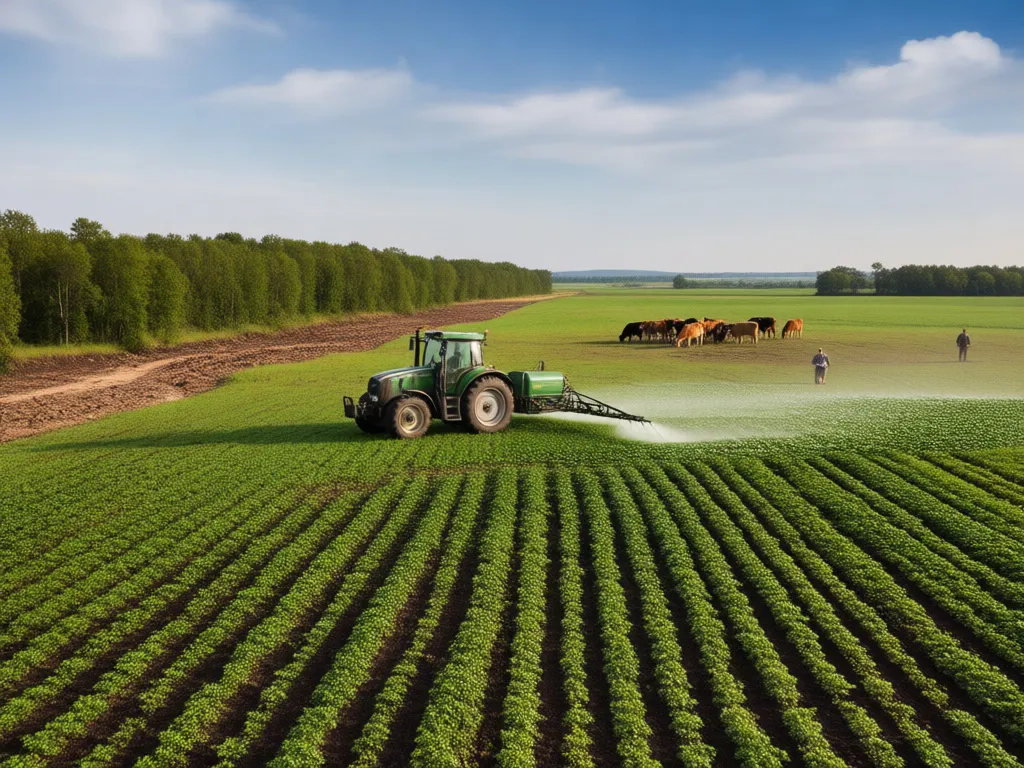
Where agricultural emissions come from
Agricultural emissions are usually discussed as if they were one thing, but they come from several different sources. The biggest are often fertilizer related nitrous oxide, methane from livestock and manure, and carbon dioxide released when land is converted for farming or when soil carbon changes over time.
That matters because each source behaves differently. Fertilizer emissions are tied to how nitrogen moves through soil. Methane is produced in oxygen poor conditions, especially in ruminant digestion and some storage systems. Land use emissions depend on what land was there before agriculture expanded and how the land is managed afterward.
When people ask why food has a climate footprint, these three areas are often the core of the answer.
Why fertilizer is linked to emissions
Nitrogen fertilizers can increase crop yields, but not all nitrogen added to fields is taken up by plants. Some is lost through runoff, some volatilizes, and some is transformed by soil microbes into nitrous oxide, a potent greenhouse gas.
The important point is that emissions do not come only from the fertilizer itself as a product. They come from how much reactive nitrogen enters the system and how efficiently plants use it. The more surplus nitrogen that remains in soil, the greater the chance that microbial processes will release nitrous oxide.
This is why the same crop can have different emissions depending on fertilizer timing, application rate, soil type, weather, and irrigation. A field that gets more nitrogen than the crop can use is likely to create more losses than a field managed more precisely.
There is also an upstream component. Manufacturing synthetic nitrogen fertilizer uses energy, and that adds emissions before the fertilizer even reaches the farm. So fertilizer affects emissions both on the farm and in the supply chain that produces the input.
How methane fits into agriculture emissions
Methane is central to agriculture because it is released by biological processes, not just fuel combustion. In farming, the most discussed source is enteric fermentation, which occurs in the digestive systems of cattle, sheep, and other ruminants. Methane is also emitted from manure when it decomposes without much oxygen.
Methane matters because it has a strong warming effect over a shorter time frame than carbon dioxide. That means reductions can have a relatively fast climate benefit compared with many other measures, although the exact accounting depends on the method being used.
Livestock systems differ in how much methane they produce. Species, feed quality, productivity, housing, manure handling, and herd management all influence emissions. For example, a system that stores manure in anaerobic conditions will usually produce more methane than one that handles manure in ways that reduce oxygen free decomposition.
It is also useful to separate methane from the broader livestock footprint. Methane is only one part of it. Feed production, fertilizer used for feed crops, energy use, and land conversion can all add emissions alongside methane.
Why land use is such a large part of the picture
Land use affects emissions in two main ways. First, changing forests, wetlands, or grasslands into cropland or pasture can release stored carbon from vegetation and soils. Second, ongoing land management can either preserve soil carbon or reduce it over time.
When land is converted, the climate impact can be large because ecosystems store carbon for long periods. Clearing land for agriculture can release that stored carbon quickly. In many climate assessments, this is one of the most consequential sources of emissions in the food system.
Land use also influences future emissions by shaping what can be produced and how intensively it can be produced. A farm that expands onto previously unmanaged land may increase output, but it may also create a large one time carbon cost. That is why land use change is often treated separately from routine farm emissions.
It is important not to assume that all local or small scale farming is automatically lower in emissions. The climate effect depends on what land was used before, how much carbon was stored there, and what the farm replaces.
How these three sources interact
Fertilizer, methane, and land use are often discussed separately, but in practice they interact.
Livestock systems use land for grazing and for growing feed. That means methane from animals is often connected to fertilizer emissions from feed production and to land use emissions from pasture expansion or feed crop cultivation.
Crop systems can also drive land use change when yields are low or when demand expands faster than production efficiency. In that case, fertilizer use may rise to support output, but the climate effect will depend on whether the higher yield avoids new land conversion or simply adds more nitrogen losses.
This is one reason whole system thinking matters. A narrow fix aimed at one emission source can shift the problem elsewhere. Reducing fertilizer without managing yield can push farming onto more land. Increasing livestock efficiency without reducing herd size may still leave methane high if total production keeps rising.
What farmers and buyers should look at first
If the goal is to reduce agricultural emissions, the first step is usually to identify which source dominates in a given system. The right actions depend on whether the main issue is fertilizer losses, methane from animals, or land related carbon change.
For crop systems, nitrogen use efficiency is a useful starting point. That means asking whether fertilizer rates match crop need, whether application timing is well aligned with plant uptake, and whether soil testing or precision methods could reduce excess nitrogen.
For livestock systems, the main questions are about herd structure, feed quality, manure handling, and the amount of methane produced per unit of milk or meat. Improving productivity can reduce emissions intensity, but the total climate effect still depends on overall output.
For land use, the key question is whether production depends on converting natural ecosystems or whether it can be met on existing agricultural land. Protecting high carbon ecosystems usually matters far more than marginal changes in field management.
Common misunderstandings about agricultural emissions
One common mistake is to treat all farming emissions as if they were the same as fossil fuel emissions. They are not. Some agricultural emissions come from biological cycles, while others come from energy use and land conversion. That difference affects how they are measured and how they can be reduced.
Another misunderstanding is to assume that reducing one emission source automatically solves the whole problem. Better fertilizer management does not eliminate methane from ruminants. Lower methane from manure does not remove the need to address nitrogen losses. Avoiding deforestation does not remove emissions from soil management.
It is also easy to overstate the climate value of a single practice without considering context. A practice that works well in one region or crop may not deliver the same result elsewhere because soils, weather, economics, and production systems differ.
What actually tends to make a difference
In practical terms, the biggest gains usually come from actions that reduce waste and avoid new land conversion. That includes improving fertilizer use efficiency, preventing expansion into carbon rich ecosystems, and managing manure in ways that reduce methane formation.
Changes in diet and demand can matter as well because they influence how much land and livestock production is needed overall. But from an emissions accounting perspective, the path to lower impact still runs through the same major sources: nitrogen losses, methane generation, and land use change.
For organizations that buy agricultural commodities or food, this means the most useful questions are often about sourcing, land conversion risk, fertilizer management, and methane reduction strategies rather than broad sustainability labels alone.
How to read claims about low emission agriculture
When you see a claim about lower agricultural emissions, check what it actually covers. Does it refer only to on farm emissions, or does it include fertilizer manufacturing and land use change? Does it measure emissions per kilogram of product, or total emissions from the system? Does it account for changes in land carbon over time?
These questions matter because two products can have similar reported numbers for different reasons. One may look efficient per unit of output but still depend on land conversion elsewhere. Another may have higher emissions intensity but avoid major land use change. The accounting boundary changes the answer.
For readers trying to understand the climate impact of food, the safest approach is to focus on the main sources and the system boundary rather than on a single headline figure.
What to remember when comparing food systems
The climate footprint of agriculture is shaped by how nitrogen is used, how methane is generated, and how land is managed. Fertilizers matter because surplus nitrogen can become nitrous oxide and because fertilizer production itself uses energy. Methane matters because livestock and manure release a gas with strong warming effects. Land use matters because converting natural ecosystems can release stored carbon and lock in future emissions.
That framework is useful whether you are comparing crops, livestock, supply chains, or farming policies. It helps explain why some interventions work well, why others are limited, and why the biggest wins usually come from looking at the full agricultural system rather than one input in isolation.
For a more complete assessment, the next question is not only how food is produced, but also where it comes from, what land it depends on, and which greenhouse gases are being counted in the analysis.