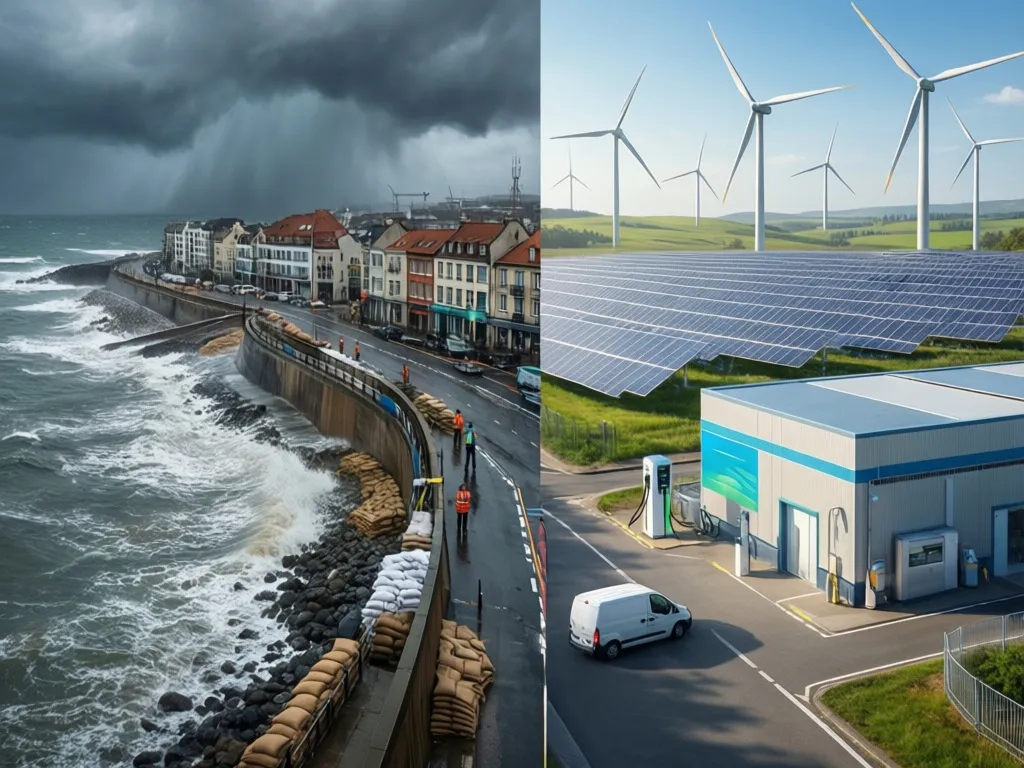
Adaptation and mitigation solve different problems
Climate action is often grouped into two broad categories. Mitigation means reducing the causes of climate change, mainly by cutting greenhouse gas emissions or increasing removals. Adaptation means adjusting systems, buildings, operations, and habits so people can live and work with the climate impacts that are already happening or are likely to happen.
That difference matters because a flood wall does not lower emissions, and an emissions reduction target does not stop a heatwave next summer. Businesses and communities need both if they want to manage present risks while also reducing the scale of future ones.
What mitigation looks like in practice
For businesses, mitigation usually shows up in energy efficiency, electrification, renewable electricity procurement, process changes, lower carbon materials, logistics redesign, waste reduction, and product changes that lower lifetime emissions. The goal is to reduce the company’s contribution to climate change across direct operations and, where relevant, the wider value chain.
For communities, mitigation can mean cleaner public transport, building efficiency programs, district energy, urban design that supports lower car dependence, landfill methane capture, tree planting where it is appropriate, and better land management. It also includes policies that make low carbon choices easier and cheaper for households, schools, and local institutions.
Mitigation is about the future climate system. The benefits build over time, because lower emissions today reduce the amount of warming that accumulates later. That makes mitigation essential even when the effects are not immediately visible.
What adaptation looks like in practice
Adaptation is about handling climate stress that cannot be avoided in the short term. A business may need to protect staff from extreme heat, maintain operations during flooding, secure water supply, or make supply chains more resilient to storms and drought. A community may need better drainage, cooling centers, wildfire preparedness, emergency communication, or updated building standards.
The best adaptation actions are usually specific to local risks. Coastal flooding, heat, wildfire, water scarcity, and severe storms do not affect every place in the same way. A useful adaptation plan starts with hazard assessment, exposure, and vulnerability rather than with a generic list of climate ideas.
Adaptation does not eliminate risk completely. It lowers the likelihood of harm, reduces damage when climate events happen, and helps essential services recover faster. In many cases, the most valuable adaptation measures are also the least visible because they prevent disruption rather than respond to it.
Why businesses should not treat this as an either or choice
For businesses, adaptation and mitigation are connected. A company that only focuses on adaptation may become better at surviving climate shocks while still contributing to the problem. A company that only focuses on mitigation may improve its climate profile on paper but remain exposed to costly disruptions from heat, water stress, supply interruptions, or insurance changes.
The right balance depends on business model, geography, sector, and time horizon. A food processor in a drought prone area may need immediate adaptation for water resilience as well as emissions reductions in energy and logistics. A property owner in a flood plain may need physical protections and also a plan to lower building emissions through retrofit and electrification. A software company may face lower physical exposure but still need mitigation through procurement, travel policy, and data center choices, along with adaptation for office continuity and employee wellbeing during heat events.
For most organizations, climate strategy works better when adaptation and mitigation are handled together. That allows leaders to see where one action supports the other and where tradeoffs need attention.
Why communities need both as well
Communities also face a dual challenge. They need mitigation to reduce long term warming and adaptation to manage present damage. Local governments, utilities, nonprofits, schools, and neighborhood groups all influence both sides, even when they do not control every asset directly.
Community mitigation often works through infrastructure and policy. Public transit, building codes, zoning, waste systems, and procurement can all reduce emissions at scale. Community adaptation often works through preparedness, infrastructure reinforcement, public health planning, and social support networks. A community that invests in shaded streets, accessible cooling, flood aware land use, and emergency planning is often better protected than one that depends on a single major project.
Community action matters because the people most affected by climate impacts are not always the people with the most resources to respond. Good adaptation therefore needs attention to equity, access, and communication. Good mitigation needs similar care, because climate policies can become unpopular or ineffective if they ignore affordability and practical constraints.
How to decide which actions belong in adaptation and which belong in mitigation
A useful way to sort actions is to ask what problem each measure is meant to solve. If the answer is reducing emissions or removing greenhouse gases, it is mitigation. If the answer is reducing harm from climate impacts, it is adaptation. Some measures do both.
Energy efficient buildings are a common example. Better insulation and efficient systems can lower emissions, which makes them mitigation measures. The same improvements can also make indoor spaces more comfortable during heat events, which gives them an adaptation benefit. Shade trees, green roofs, water conservation, and resilient infrastructure can also sit in both categories depending on design and purpose.
This overlap is useful, but it can also create confusion. A project should not be counted as solving both problems unless the benefits are real and relevant. For example, planting trees can support cooling and reduce some emissions, but the climate value depends on species, survival, location, and long term maintenance. It is better to describe the actual function than to assume a broad benefit.
Common mistakes when comparing adaptation and mitigation
One common mistake is to assume adaptation is a short term fix and mitigation is a long term concern. In reality, both need time horizons. Some mitigation actions pay off quickly, while some adaptation measures take years of planning, permitting, and construction. Another mistake is to assume one can replace the other. They cannot.
Another problem is choosing actions only because they are visible. A community may prefer a new public awareness campaign over updated drainage systems because the campaign is easier to announce. A business may prefer a sustainability pledge over building retrofit because the pledge is simpler to publish. Visibility does not equal effectiveness.
A third mistake is underestimating dependencies. Adaptation can fail if underlying emissions continue rising and climate impacts intensify faster than expected. Mitigation can stall if people and systems are already overwhelmed by heat, storm damage, or financial stress. Climate planning works best when immediate resilience and long range emissions cuts are both part of the design.
What businesses should do first
Businesses usually need a practical sequence rather than a theory lesson. The first step is to identify the main climate risks to operations, workforce, assets, suppliers, and customers. That means looking at physical hazards and also transition risks such as policy change, market shifts, reporting pressure, and financing conditions.
The second step is to identify the biggest emissions sources. For many organizations these will be energy use, purchased goods and services, transport, logistics, and capital assets. The aim is not perfect measurement on day one. The aim is to find the largest levers so resources go where they matter most.
The third step is to compare measures that reduce both risk and emissions, because those often offer the most practical value. Examples include building improvements, fleet changes, water efficiency, supplier diversification, and business continuity planning that also supports lower resource use. Where tradeoffs exist, decision makers should make them explicit rather than hiding them inside a single sustainability label.
What communities should do first
Communities benefit from a similar process, but the starting point is often broader because many actors share responsibility. The first task is to understand local hazards and who is most exposed. Heat risk is not only about temperature. It is also about tree cover, housing quality, access to cooling, health conditions, and the ability to reach help.
Then communities need to identify the largest sources of local emissions and the systems that shape them. That might include buildings, transport, waste, electricity supply, or land use. After that, local leaders can look for measures that improve everyday quality of life while also lowering emissions or strengthening resilience. Examples include transit access, shade, safer walking and cycling routes, efficient public buildings, and emergency planning that reaches people who are often missed.
Community efforts work best when they are grounded in trust. Residents are more likely to support climate measures when they understand why they are needed, who benefits, what they cost, and how decisions were made. This is especially true where adaptation involves hard choices about land use or infrastructure priorities.
How to balance near term resilience with long term emissions cuts
The main practical challenge is balancing urgent risk reduction with the slower work of decarbonization. The easiest way to do this is to use one planning process with two lenses. Every major project should be checked for its effect on emissions and its effect on resilience.
That does not mean every project must do both equally well. Sometimes the priority is adaptation because an immediate hazard is clear. Sometimes the priority is mitigation because a high emitting system is ready for change. But even then, teams should ask whether the chosen action creates lock in, shifts risk elsewhere, or closes off better options later.
For example, investing in a new fossil fuel dependent asset may meet a short term resilience need but create future cost and emissions exposure. On the other hand, investing only in efficiency without preparing for heat, floods, or supply shocks may leave operations fragile. Good decisions weigh both sets of consequences before money is spent.
How to measure progress without confusion
Mitigation metrics usually focus on emissions, energy use, fuel consumption, renewable electricity, or intensity measures tied to output. Adaptation metrics are different. They often track risk reduction, downtime avoided, service continuity, recovery time, preparedness, coverage, or the number of people protected by a measure.
Because these are different kinds of outcomes, it is a mistake to force them into a single number without context. A better approach is to report them separately and explain how they support the same overall strategy. A business can track emissions reductions and resilience improvements in parallel. A community can report progress on cooling access, flood protection, emergency readiness, and emissions reductions without pretending they are interchangeable.
Decision makers should also watch for false comfort. A plan that lists many adaptation actions is not necessarily effective if the highest risks remain unaddressed. A plan that reports emissions reductions is not necessarily resilient if it ignores physical exposure. The measure should match the problem.
When adaptation and mitigation reinforce each other
The strongest climate strategies often find overlap between the two. Retrofitting buildings can lower energy demand and improve comfort during heat events. Cleaner transport can reduce emissions and improve air quality. Water efficiency can lower operating costs and help during drought. Urban shade can reduce heat stress and make walking more attractive, which can support lower transport emissions.
These combined benefits are important because they make climate action easier to justify and easier to sustain. They also help different departments or stakeholders see value in the same project. Finance may care about avoided losses, facilities may care about lower operating costs, and public health teams may care about cooler, safer spaces. A single well designed action can serve several goals at once.
Still, overlap should be tested rather than assumed. Each project should be checked for its real operating conditions, maintenance needs, and lifespan. Measures that work in one location or sector may not transfer cleanly to another.
Questions businesses and communities should ask before acting
Before launching a climate project, it helps to ask a few practical questions. What risk or emission source is this meant to address? Who benefits, and who carries the cost? How will success be measured? Does the measure create long term flexibility, or does it lock in a narrow path? What maintenance, governance, or behavior change will it require?
Those questions force clarity. They also make it easier to explain a plan to boards, residents, employees, funders, and partners. Climate action is more durable when people can see the reason behind the choice and the evidence for the expected outcome.
For businesses and communities alike, the real decision is not adaptation versus mitigation as if one must win. The better question is how to choose the right mix of both, in the right order, for the risks and emissions that matter most now.
Related planning resources
If you are building a broader climate strategy, it can help to connect this topic with other planning work such as climate risk assessment, decarbonization roadmap design, resilience planning for operations, and community engagement for climate projects. Those topics help turn the difference between adaptation and mitigation into a practical decision process.