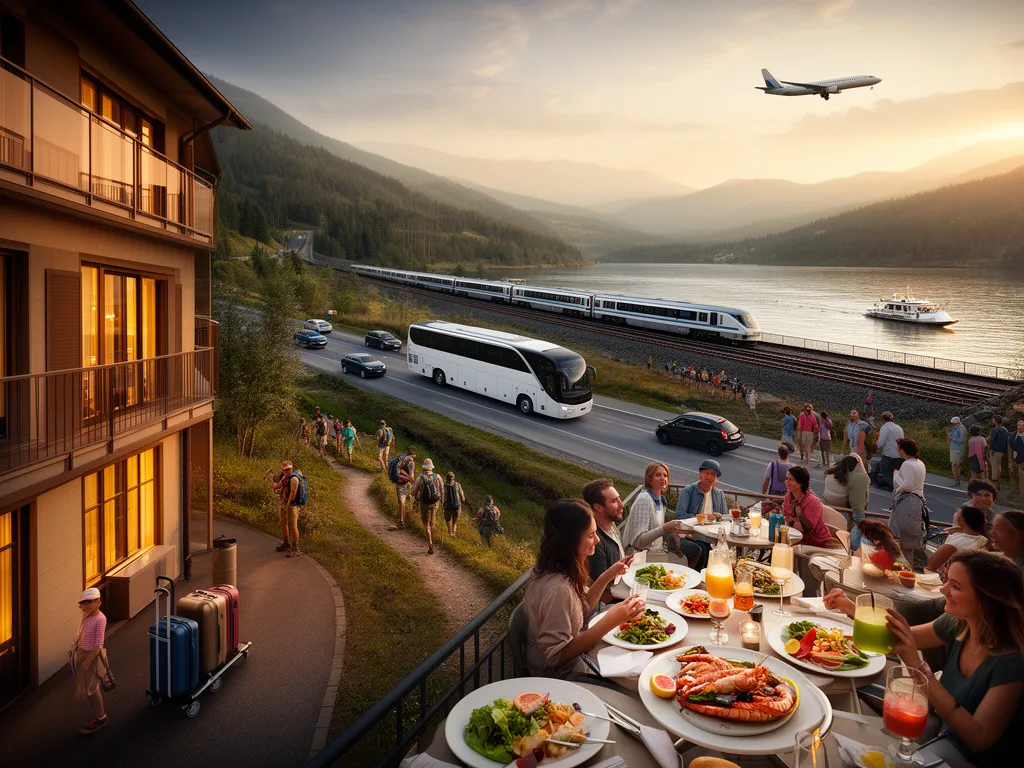
Tourism emissions are spread across the whole trip
A tourism footprint is not created by one single choice. It comes from the combined effect of how you travel, where you stay, what you eat, and what you do once you arrive. That is why a trip with a modest hotel but a long flight can still have a high footprint, while a train based holiday with local meals and low intensity activities may be much lower.
If you want to understand tourism carbon footprint in a useful way, the right question is not whether one part of the trip is sustainable on its own. The better question is which parts of the trip matter most, and which decisions give the biggest reduction without changing the trip beyond recognition.
Transport often dominates the footprint
For many trips, transport is the largest source of travel emissions, especially when flying is involved. The basic reason is simple: moving people over long distances usually takes a lot of energy, and planes are typically much more emission intensive per passenger than trains, coaches, or full cars. The exact result depends on distance, occupancy, aircraft type, routing, and the other transport options available, but the pattern is consistent enough to guide decisions.
Short trips can be especially sensitive to mode choice. A rail or coach journey may replace a flight entirely in some corridors, while in other places there is no practical substitute. Where there is a realistic alternative, mode choice is often the biggest decision lever for reducing the footprint of tourism.
When road travel is part of the trip, occupancy matters. A full car spreads emissions across more people than a solo driver, although the total still depends on the vehicle and distance. For local sightseeing, walking, cycling, and public transport usually have far lower emissions than repeated car use.
What to consider when choosing transport
Think first about whether the destination is reachable without flying. If it is, compare the full journey time, cost, and practicality of rail or coach. If flying is unavoidable, then reduce avoidable extra flights, choose direct routes when possible, and combine activities into fewer trips once you arrive.
It also helps to consider the transport used at the destination. A low carbon arrival can be partly offset by daily taxi use, rental car dependence, or long transfers between scattered attractions.
Accommodation matters, but the size of the effect varies
Hotels, guesthouses, resorts, holiday rentals, and serviced apartments all use energy and water. Heating, cooling, hot water, laundry, cooking, lighting, and shared facilities all contribute to operational emissions. The footprint of accommodation depends on the building, the local climate, the length of stay, and how intensively the property is used.
Per night emissions can be lower when a property is well occupied, because fixed energy use is shared across more guests. That does not mean a crowded property is always the better choice in every respect, but it does show why occupancy and building efficiency both matter. A large room or villa can easily use more energy than a smaller room if climate control is running for longer periods.
Guest behavior also matters. Air conditioning set very low, towels and linens changed more often than needed, and leaving lights or appliances on can increase energy use. These choices may seem small individually, but they add up across a stay and across large numbers of visitors.
How to judge accommodation more carefully
Rather than relying on broad sustainability language, look for evidence of operational practices. Useful signs include energy efficient heating and cooling, water saving fixtures, laundry practices that reduce unnecessary washing, and clear information about how the property manages waste and energy.
Location matters too. A centrally located stay may reduce the need for car use, airport transfers, and long taxi rides. In many trips, that can be more important than small differences between two similar hotels.
Food can be a significant part of the trip footprint
Food is easy to overlook in tourism because it feels separate from travel itself. In reality, meals are a daily emissions source throughout the trip. The footprint of food depends on what is served, how it is produced, how far it is transported, and how much waste is created.
General patterns are well established. Meals with more animal sourced ingredients tend to have higher emissions than plant rich meals, especially when beef and dairy are involved. That does not mean all local specialties are high impact or all plant based meals are low impact in every case, but the broad relationship is consistent enough to inform planning.
Food waste is also important. Buffets, oversized portions, and over ordering can increase emissions without improving the travel experience. Because tourism often involves eating out more frequently than usual, avoiding waste can make a real difference.
How to make food choices without turning travel into a project
If you want lower food emissions while traveling, the simplest approach is to choose meals with more plant based ingredients more often, reduce unnecessary food waste, and be selective with high impact foods rather than trying to control every meal. Local sourcing can help in some cases, but it is not automatically better than imports, because production methods usually matter more than food miles alone.
Practical choices also depend on the type of trip. On a short city break, the food footprint may be smaller than transport but still worth considering. On a longer trip with many restaurant meals, food becomes more relevant because the emissions repeat day after day.
Activities range from low intensity to energy intensive
The activity part of tourism is broad. A walking tour, museum visit, beach day, or self guided neighborhood exploration usually has a small direct footprint. By contrast, motorized excursions, boat trips, powered recreation, and activities that require heavy energy use can add more emissions.
Some activities are not high in direct energy use but still influence the footprint through logistics. If an experience requires multiple transfers, long detours, or purpose built facilities with large energy demands, the overall impact can be higher than it first appears.
The best way to think about activities is not by labels such as eco friendly or not. It is better to ask what resources the activity needs, how many people it serves at once, and whether the same experience could be delivered in a lower intensity way.
Choosing activities with lower emissions in mind
Low intensity tourism often looks simpler. Walking, cycling, cultural visits, nature observation, and public transport based exploration can be relatively light on emissions and still be memorable. Shared group experiences can also be more efficient than private ones when they replace multiple separate trips.
That said, the goal is not to avoid all paid activities. It is to be aware of which choices add significant transport or energy demand and which do not. If a high impact activity is central to the trip, it may be worth keeping it while reducing impact elsewhere.
Why the footprint is best understood as a system
A common mistake is to treat each travel choice as if it were independent. In practice, accommodation, transport, food, and activities interact. A destination reached by train may encourage a slower trip with more local meals and less movement, while a flight based holiday may involve more transfers and more intensive use of transport at the destination.
This is why a full trip view is more useful than a single category. If you only focus on hotel energy, you may miss the larger impact of transport. If you only focus on transport, you may ignore a resort stay with high energy demand and constant chauffeured travel. A complete picture helps you identify where effort matters most.
For businesses in tourism, this systems view is also important for communicating responsibly. It is not enough to highlight one low impact feature if the rest of the guest journey drives a much larger share of emissions. Credible communication needs to reflect the whole experience.
How to reduce tourism emissions without losing the trip
The most effective approach is usually to target the largest source first. For many travelers, that means transport. If you can choose a nearer destination, take rail instead of flying, or stay longer so that the transport emissions are spread over more days, the effect can be substantial.
After that, look at accommodation and on trip mobility. A centrally located stay, fewer transfers, lower energy use in the room, and fewer car dependent activities all help. Food choices are often the next practical area, especially on longer trips, because they are repeated every day.
It is also useful to separate what is easy from what is meaningful. Not every low impact action is equally valuable. Turning off unused lights is sensible, but it will not usually matter as much as choosing transport or reducing unnecessary car use. The point is to focus on the largest levers first and then layer in the smaller ones where they are convenient.
Planning questions that improve decisions
Before booking, it helps to ask a few simple questions. Can the destination be reached without flying. Is the stay located in a way that reduces extra transport. Will I spend most of the trip in one place or moving around repeatedly. Are the meals likely to be heavy in high impact ingredients. Which activities require significant transport or energy use.
These questions do not require exact footprint calculations to be useful. They help you compare options with better judgment, especially when two trips look similar on price and convenience but differ substantially in emissions.
For travel planners and tourism operators, the same questions can shape better offers. Bundling rail access with accommodation, improving public transport information, reducing unnecessary transfers, and designing lower intensity local experiences can all reduce the footprint of a trip without making it less appealing.
What a credible footprint conversation should include
Any serious discussion of tourism carbon footprint should acknowledge uncertainty. The exact number depends on the route, the property, the menu, the season, and the behavior of travelers. That is why broad claims should be treated carefully unless they explain what is included and how the estimate was made.
Still, uncertainty does not make the topic impossible to act on. The main patterns are clear enough to support better choices. Long distance transport, especially flying, often dominates. Accommodation and local mobility matter next. Food and activities can be smaller or larger depending on the trip, but they are still part of the total and should not be ignored.
If you want to use this information well, start with the part of the trip that is hardest to replace and has the largest likely effect. Then work through the rest of the journey with the same logic. That approach keeps the focus on the emissions that matter most while preserving the purpose of travel itself.
Useful internal links for this topic could connect to pages on transport emissions, hotel sustainability, food footprint basics, and low impact travel planning.