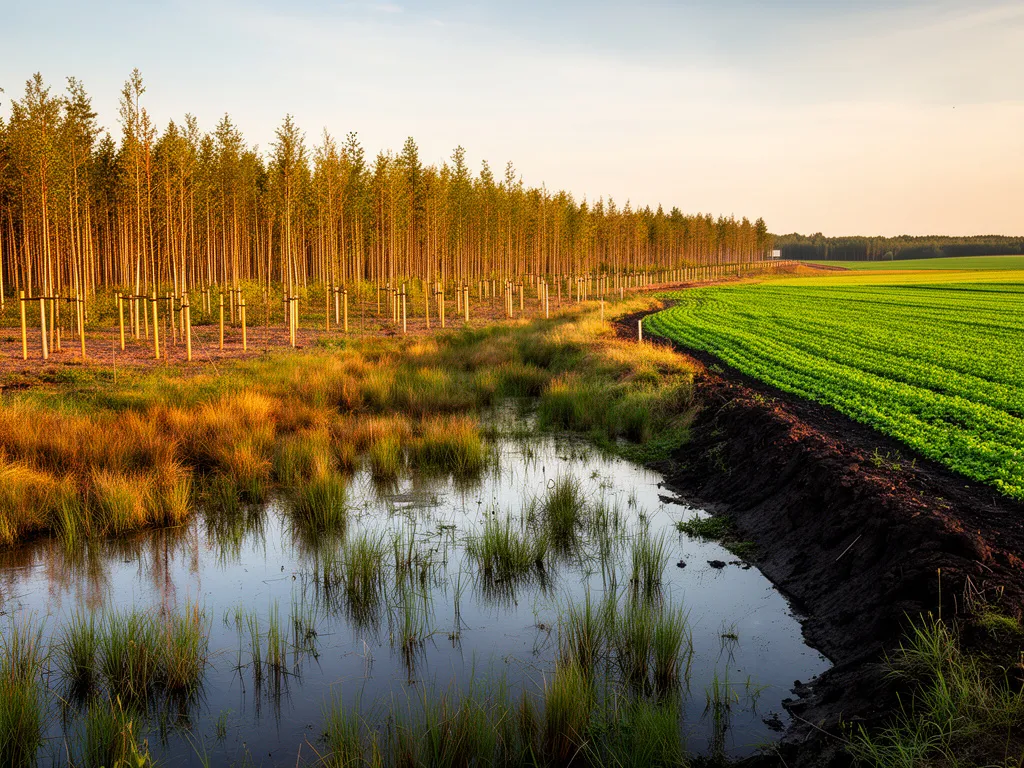
How nature based solutions store carbon
Plants and soils capture carbon through biological processes that convert atmospheric carbon dioxide into organic matter. In forests carbon accumulates above ground in trunks, branches and leaves and below ground in roots and soil organic matter. Soils hold carbon largely as decomposed plant material and microbial products that can persist for years to centuries when conditions slow decomposition. Wetlands store carbon in plant biomass and in saturated soils where low oxygen slows microbial breakdown, creating long lived peat or organic sediment in many cases.
Two separate concepts matter for climate action
Carbon sequestration is the process of removing carbon dioxide from the atmosphere and storing it in biomass, soil or sediment. Permanence refers to how long that stored carbon remains out of the atmosphere. For nature based approaches permanence is conditional on future land management and exposure to disturbances such as fire, drainage or conversion to agriculture. Credible climate contributions require both measurable sequestration and realistic assessment of permanence and reversal risk.
Reforestation: approaches and trade offs
Reforestation can mean planting trees on former forest land or enabling natural regeneration. The choice between planting and regeneration depends on site conditions, seed sources, invasive species pressure and local objectives. Natural regeneration often restores native composition and structure with lower costs, while planting allows selection of species and spatial patterns where regeneration is not possible.
Key trade offs that influence outcomes include biodiversity, water use and social impact. Monoculture plantations can sequester carbon quickly but typically offer fewer biodiversity and ecosystem service benefits than mixed native forests and can use more water. Projects that displace food production or fail to secure local tenure can generate social conflict and leakage where deforestation shifts elsewhere. Designing projects to support local livelihoods and to follow ecological suitability avoids many common failures.
What to require when evaluating a reforestation project
Demand clear land tenure documentation and evidence that the area would not have reforested without the project. Look for project plans that prioritize native species, phased implementation, and measures for fire management and pest control. Confirm monitoring plans that combine remote sensing for canopy cover with field plots for biomass sampling using standard allometric methods. Contracts should specify who bears reversal risk and what triggers restoration actions if losses occur.
Soil carbon practices: opportunities and limits
Soil carbon increases when plant inputs exceed decomposition losses. Practices that raise organic inputs or slow decomposition create a net gain. Examples include reduced or no tillage, cover crops, diverse crop rotations, agroforestry and adding organic amendments. In grasslands, improved grazing management that maintains plant cover and root production supports soil carbon accumulation.
Soil carbon gains are often incremental and site specific. Physical and chemical soil properties, climate, previous land use and management intensity strongly influence the potential for additional carbon storage. Gains in the topsoil can be reversed by tillage, deep plowing or conversion of land. For this reason projects must specify baseline practices and maintain long term commitments to preserve stored carbon.
Measurement and verification for soils
Measuring soil carbon relies on repeated soil sampling and laboratory analysis combined with models that interpolate across space and time. Robust approaches use stratified sampling to account for variability with depth and landscape position, clear reporting of sample depth, and uncertainty estimation. Remote sensing cannot measure soil organic carbon directly but can support stratification and extrapolation paired with ground data. Buyers should require transparent baselines, documented sampling protocols and uncertainty bounds on reported gains.
Wetland restoration: peatlands and coastal systems
Wetlands are effective carbon reservoirs because saturated soils slow decomposition. Restoring wetlands commonly involves rewetting drained peatlands, removing drainage infrastructure, or restoring tidal flow in coastal marshes and mangroves. Rewetting peatlands halts ongoing emissions from aerobic decomposition and over time can rebuild peat. Restoring tidal exchange in coastal systems can revive natural sedimentation and blue carbon processes.
Risks and trade offs differ by wetland type. Rewetting can raise water tables and affect agricultural use or infrastructure. Methane emissions can increase in some restored freshwater wetlands, which requires careful assessment because methane has a shorter but stronger warming effect than carbon dioxide. Credible project design includes consideration of greenhouse gas trade offs, hydrological modelling and local land use and social implications.
Indicators of a sound wetland restoration project
Look for hydrological baseline studies, explicit plans to reestablish natural water regimes, and measures to avoid shifting impacts to other areas. Projects should monitor both carbon dioxide and methane fluxes where relevant, track vegetation recovery and sediment dynamics, and document how restoration affects local livelihoods such as fisheries or grazing.
Common risks across nature based solutions
Several risks recur across reforestation, soils and wetlands. Additionality concerns whether the carbon gain would have happened anyway. Leakage occurs when protection in one place causes emissions to shift elsewhere. Reversals happen when stored carbon is lost through fire, pests, drainage or land use change. Measurement uncertainty is often larger for soil carbon than for above ground biomass and can lead to overclaiming. Social risks include inadequate consultation with affected communities, unclear benefit sharing and tenure conflicts.
How buyers and policymakers can evaluate credibility
First, insist on transparent baselines and additionality tests that are appropriate to the project type and context. Second, require an explicit risk management plan that addresses reversal risk and leakage. This can include buffer pools or insurance mechanisms and contractual requirements for long term stewardship. Third, verify monitoring, reporting and verification methods that combine remote sensing, field measurements and conservative assumptions where uncertainty is high.
Policy instruments matter. Long term conservation easements, secure tenure arrangements and integration with local land use planning reduce reversal risk. Payment structures that connect flows to verified outcomes and that fund local capacity for monitoring and management make lasting results more likely.
Design choices and decision criteria for implementation
Choose interventions that match ecological potential and social goals. Where biodiversity recovery is important, prioritize natural regeneration and mixed native plantings. Where food security is essential, favor practices such as agroforestry that combine production with carbon benefits. For soils, prioritize practices that are compatible with farmers reliance on the land and that provide short term agronomic benefits in addition to carbon gains. For wetlands, prioritize hydrological restoration and avoid actions that retain drainage or partial freshwater isolation without addressing emissions.
Practical checklist for project developers
- Document land tenure and free prior and informed consent where communities are affected.
- Provide a clear baseline and justification for additionality.
- Use mixed methods monitoring that pairs remote sensing with field plots and soil sampling.
- Include hydrological assessments for wetlands and fire management plans for forests.
- Plan for long term financing of maintenance and monitoring beyond initial restoration.
Monitoring, reporting and verification in practice
MRV systems should report methods, uncertainty and temporal coverage. For forests this typically means a combination of satellite based canopy metrics and periodic ground inventory using allometric equations. For soils it requires stratified soil sampling with reported sample depths and lab protocols. For wetlands MRV should quantify both carbon dioxide and methane where relevant and include hydrological indicators. Independent third party verification strengthens credibility, as does public disclosure of monitoring data and methodologies.
Co benefits and when they matter
Nature based solutions often deliver benefits beyond carbon including improved biodiversity, water regulation, flood protection, soil health and livelihood support. These co benefits are legitimate objectives in their own right and can increase project resilience by aligning local incentives with conservation. When purchasing carbon credits, buyers should decide whether and how to value co benefits, and look for projects that document social and ecological outcomes with the same rigor used for carbon accounting.
Practical rules for buyers and policymakers
Favor projects with conservative accounting, transparent monitoring and clear long term stewardship. Avoid credits that rely solely on short term offsets without measures to manage reversal risk. Support projects that integrate local rights and livelihoods and that demonstrate measurable co benefits. For policymakers, aligning land use policy, agricultural incentives and conservation finance reduces the pressure that drives leakage and increases the chance of durable outcomes.
Nature based solutions are powerful tools but they are not a substitute for rapid reductions in fossil fuel emissions. They can buy time and deliver local benefits while reducing net emissions if designed and managed with rigorous attention to ecological suitability, permanence, measurement and social equity.