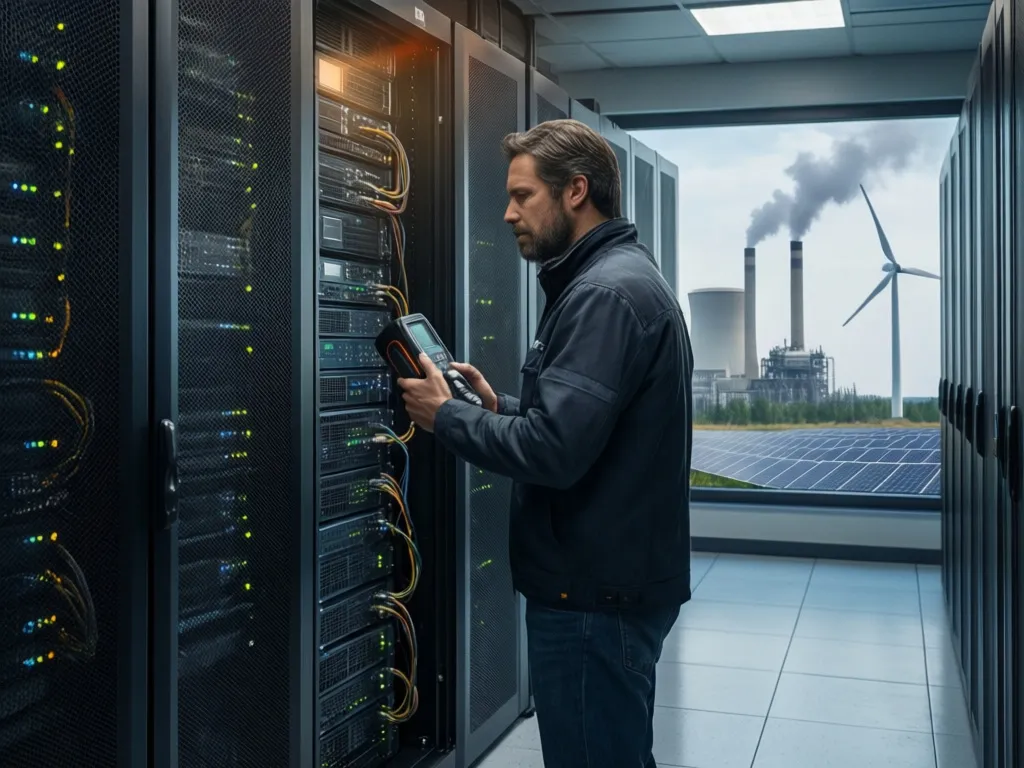
Where emissions arise in an ML lifecycle
Emissions from machine learning come from electricity and infrastructure used at multiple stages. Major sources include data collection and storage, data preprocessing and augmentation, model training and hyperparameter search, evaluation and benchmarking, production inference and serving, monitoring and retraining, and the lifecycle of hardware and cloud resources used to run these tasks. Each stage has different levers for reduction and different measurement needs.
Data collection and storage
Collecting raw data can require distributed sensors, user device uploads, crawling and transfer, and large object storage. Storing large datasets for long periods increases baseline emissions through ongoing storage and replication. Preprocessing steps such as feature extraction and large scale augmentation can also add substantial compute before any model trains. Instrumentation that tags where data came from and how often it is read will help attribute storage and preprocessing energy to specific projects.
Model training and hyperparameter search
Training is often the most visibly energy intensive stage because it uses many GPU or CPU hours. The two distinct contributors are the single training run and the search overhead caused by exploring architectures and hyperparameters. Naive grid search or exhaustive experiments multiply cost by the number of trials. The same model architecture trained many times for reliability or ensemble construction will multiply emissions further. Efficient experiment design and reuse of pretrained weights are decisive choices.
Evaluation and benchmarking
Evaluation consumes compute when run at scale or when large test suites and cross validation are used. Frequent evaluation during development and large scale benchmarking campaigns can rival training costs if not managed. Logging and rerunning evaluations without reuse of intermediate results adds avoidable overhead.
Inference and ongoing operations
Once models are deployed, inference and monitoring become steady state sources of emissions. Serving latency requirements, request volume, and model size determine energy use. Excessive polling for model health, excessive logging, or unnecessarily low caching time to live increase energy used per user request. Continuous retraining driven by drift detection or product requirements adds recurrent training emissions.
How to measure emissions reliably
All practical measurement reduces to two steps. First estimate or measure energy consumed in kilowatt hours. Second multiply energy by an emissions factor for the electricity used. The equation is energy in kilowatt hours times grams of carbon dioxide equivalent per kilowatt hour equals grams of CO2 equivalent.
Measuring energy use
Direct measurement is best. When you control hardware, use metering or power sensors. On cloud hardware, instrument the workloads to record instance type, GPU type, runtime and observed utilization. Tools exist that estimate energy from runtime, instance power profile and utilization. Where direct measurement is not possible, estimate energy using reported processor thermal design power or vendor power profiles combined with utilization and elapsed time.
Choosing an emissions factor
Electricity emissions factors vary by grid and by time. Use local grid averages for simple reporting. For more accurate attribution, use marginal emissions or time resolved grid data when available. Document whether you used average or marginal factors because the choice materially changes estimates for scheduling and for comparing regions.
Attribution to organizational reporting
How you map measured emissions into corporate greenhouse gas accounting follows established boundaries. If you run hardware you own and operate, direct fuel combustion is Scope 1 and purchased electricity is Scope 2. If you consume compute as a cloud customer, the provider electricity and infrastructure emissions are a form of Scope 3 purchased services. Make clear in disclosures which scopes include model training and inference emissions and whether you report location based or market based Scope 2 for owned sites.
Practical ways to reduce emissions at each stage
Data collection and storage
Prioritize collecting only the data you need. Use sampling and targeted labeling instead of blanket collection. Archive cold data to low redundancy storage classes and delete unnecessary copies. Compress datasets and prefer formats that allow streaming of only required features. When labeling costs drive retraining frequency, combine active learning to prioritize examples that are likely to change model behavior.
Training and experiment design
Reuse pretrained models and transfer learning when suitable. Choose model families engineered for efficiency when they meet accuracy needs. Replace exhaustive hyperparameter sweeps with informed search. Use multi fidelity search, early stopping and learning curve extrapolation to terminate poor trials early. Track and share checkpoints across experiments to avoid retraining from scratch when incremental experiments suffice.
Efficient evaluation
Cache intermediate evaluation artifacts so you do not recompute costly features. Use holdout evaluations only when necessary and adopt stratified sampling on large test sets to reduce evaluation cost while preserving statistical power. Automate statistical tests that trigger full evaluations only when sample results exceed thresholds.
Inference and production operations
Reduce model size with quantization, pruning and distillation to cut inference energy per request. Batch requests and use asynchronous processing for noninteractive workloads. Cache frequent results and enforce reasonable expiration times. Implement routing rules that send low risk requests to lightweight models and reserve heavyweight models for high value requests. Monitor request patterns and scale serving capacity to demand rather than keeping large idle pools.
Scheduling and regional choices
Schedule large training runs for times when the grid is cleaner if you can use time aware scheduling. Prefer regions with lower ongoing emissions intensity when latency and data residency rules allow. Be mindful that moving workloads changes which organization bears the emissions in accounting and may affect compliance obligations.
Operational practices and governance
Instrument experiments and production for transparency
Record for every experiment the instance type, accelerator type, runtime, utilization when available, and the dataset identifier. Add a field for energy estimate and for emissions using the factor and methodology applied. Store this metadata in experiment tracking systems so that product and sustainability teams can query aggregate emissions by model, team, dataset or product feature.
Write explicit retraining rules
Define objective criteria for retraining so models are not retrained on schedule alone. Use controlled tests of model drift and measurable degradation to trigger retraining. Where retraining is necessary, prefer incremental updates or fine tuning rather than full retrain from scratch.
Include emissions in tradeoff decisions
Treat energy and carbon as first class metrics alongside latency and cost. When evaluating model variants, report compute hours, estimated energy and emissions in decision documents. This makes the tradeoff explicit and helps teams choose efficient alternatives that still meet product requirements.
Tools and reproducible estimation methods
Use established tools to avoid ad hoc calculations. Instrumentation libraries can estimate energy per run from instance and accelerator metadata. For longer lived reporting, aggregate estimates by project and reconcile with provider level reports. Keep methodology notes that list which emissions factor source and which electricity accounting method you used so reports remain auditable and comparable over time.
Best practices checklist for teams
- Baseline measurement. Run representative workloads to estimate energy and emissions using direct measurement or a documented estimation method.
- Instrument experiments. Capture instance and runtime metadata in experiment tracking with an energy and emissions field.
- Set governance rules. Define retraining triggers, budget caps for hyperparameter search, and region preferences based on emissions factors and policy constraints.
- Optimize. Apply transfer learning, model compression and efficient search methods before resorting to more compute heavy options.
- Report and review. Include model emissions in product reviews and in sustainability reporting with documented methods and scope mapping.
What teams should avoid
Avoid treating cloud provider sustainability statements as a single source of truth without reconciliation. Providers publish a range of reports and instruments that are useful but require interpretation when mapping to customer Scope 3. Avoid blind reuse of default emissions factors across regions and across time. Avoid performing massive unbounded sweeps of architectures without early stopping and multi fidelity experiment design.
How to communicate emissions in model documentation
Include a short section in model cards that lists estimated energy and emissions for typical training runs and for per inference cost. State the methodology used to estimate emissions, the emissions factor source and the scopes under which the emissions are reported. Note any assumptions such as reuse of pretrained weights or results averaged across runs.
Next operational steps for teams just starting
Start with a small pilot that measures a representative training run. Add a column for energy and emissions to your experiment tracking. Define a modest emissions budget for experimentation and put simple guardrails in place for large scale sweeps. Use the pilot to identify the biggest levers for your workloads and build repeatable practices from there.
Clear measurement, minimal experimentation waste, reuse of models and regular governance make it possible to manage emissions across the machine learning lifecycle without compromising product goals. Transparent documentation and consistent methodology preserve auditability and help teams improve over time.