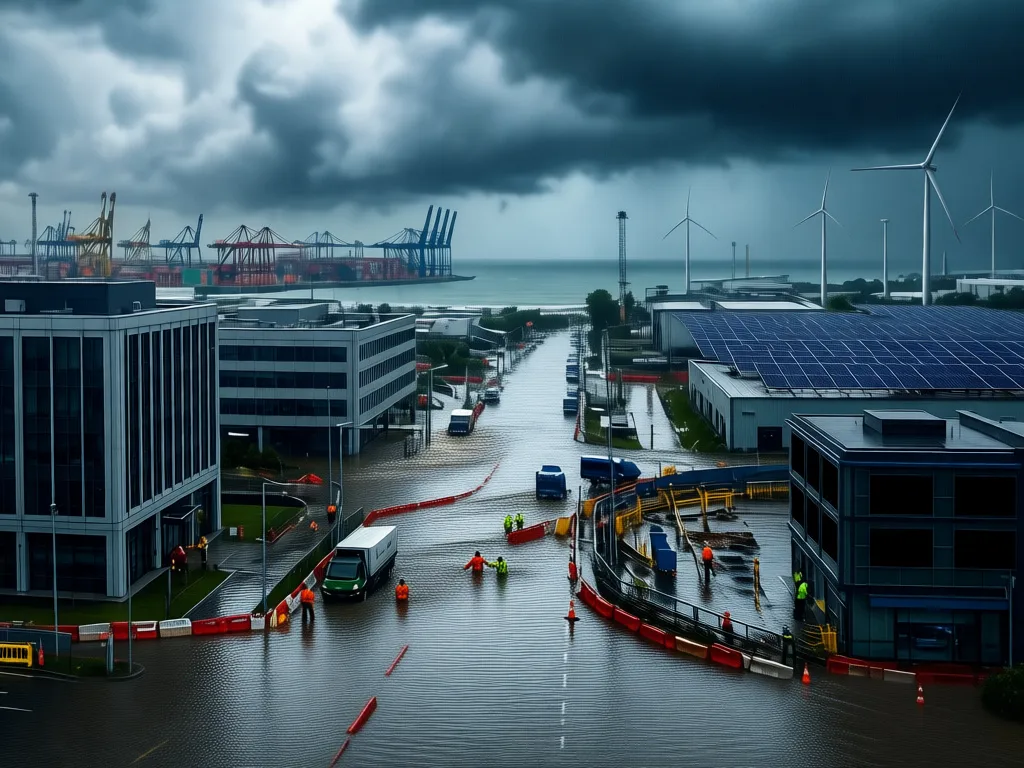
Understanding the two core climate risks
Physical risk arises from the direct impacts of weather and climate. Floods, storms, heat stress, drought and sea level rise can damage facilities, disrupt logistics and change resource availability. Physical risk matters for assets that sit in exposed locations, for workers who perform outdoor or temperature sensitive tasks, and for operations that rely on climate sensitive inputs such as water or agriculture.
Transition risk comes from the economic and policy changes as societies move to lower greenhouse gas emissions. Shifts in regulation, carbon pricing, technology adoption and market preferences can change the value of assets, increase operating costs or make business models obsolete. Transition risk affects firms in carbon intensive sectors, companies with long lived assets, and businesses whose products or services face rapid substitution.
Why separating these risks matters for business decisions
Treating physical risk and transition risk as a single concept risks under preparing for each. Physical risk often demands capital and site level adaptation. Transition risk drives strategic choices about investments, product design and engagement with policy and finance. A robust approach identifies both types, quantifies potential impacts on revenues and costs, and links responses to corporate planning cycles.
Assessing climate risk in practical steps
1. Define the boundary and materiality criteria
Start by deciding which parts of the organization to include. Materiality is business specific. Consider the relative value of assets, revenue exposure, critical suppliers and operations that cannot be easily relocated. Use the company budgeting horizon and asset lifetimes to frame how far into the future to examine risk.
2. Map hazards, exposure and vulnerability
Separate the analysis into three elements. Hazard describes the climate event or trend. Exposure identifies what could be affected. Vulnerability measures how susceptible an exposed item is to harm given its current condition and capacity to respond. This decomposition clarifies whether the priority is reducing exposure or strengthening resilience.
3. Apply scenario analysis to capture uncertainty
Climate projections and policy pathways differ. Scenario analysis helps explore a range of plausible futures rather than a single forecast. Typical scenarios vary by greenhouse gas pathway and by how fast policy and technology change. Use scenario results to test asset values, supply chain continuity and demand trajectories under different combinations of physical and transition stressors.
4. Translate climate outcomes into business metrics
Turn climate information into metrics that business units understand and can act on. Examples include expected annual downtime for a site, change in operating cost from carbon pricing, percentage of revenue at risk under specific demand shifts, or replacement cost for damaged infrastructure. Avoid abstract climate terms when addressing finance and operations teams.
5. Combine quantitative and qualitative evidence
Not all risks are immediately quantifiable. Use qualitative assessments to capture regulatory uncertainty, reputational exposures and supplier reliability. Combine these with quantitative estimates when possible, and be explicit about assumptions and confidence levels.
Resilience planning that connects risk to action
Resilience planning is about reducing likelihood and minimizing impact. It requires coordinated measures across operations, finance and strategy.
Operational and physical measures
Actions include reinforcing critical infrastructure, raising electrical and mechanical equipment above likely flood levels, hardening cooling systems to handle higher temperatures, diversifying water sources and revising maintenance regimes for weather extremes. For geographically distributed businesses, relocating or redistributing critical capacity can reduce single point failures.
Supply chain and procurement measures
Assess supplier concentration and the climate exposure of key suppliers. Encourage or require suppliers to disclose their own climate risk and resilience plans. Build redundancy into sourcing and maintain buffer inventories for truly critical inputs. Where feasible, shift to inputs and carriers with lower climate exposure to reduce both physical and transition risk.
Financial and contractual measures
Use financial instruments to manage residual risk. Insurance can transfer some short term physical losses. Contracts can allocate responsibility for climate related disruptions, but they do not eliminate systemic transition risk. Incorporate climate assumptions into capital expenditure appraisal, depreciation schedules and impairment testing to avoid stranded assets.
Product and market strategy
Adapt product portfolios to changing customer preferences and regulation. Develop lower carbon product variants and services that reduce customers vulnerability to climate impacts. Early investment in low carbon technology can turn potential transition risk into competitive advantage.
Governance, disclosure and integration into decision making
Assign clear roles and reporting lines for climate risk. Board level oversight ensures risk appetite and capital allocation reflect climate realities. Operational committees should translate strategy into investment and procurement rules. Regular internal reporting that links scenario outcomes to financial metrics supports timely decisions.
Consider established disclosure frameworks. Voluntary frameworks can improve transparency and help investors and partners evaluate your preparedness. Disclosure also fosters internal discipline by requiring consistent methods and documentation for assessments.
Practical roadmap for the first 12 to 24 months
- Map priority assets and suppliers to identify immediate exposure and collect baseline location and asset health data.
- Run a rapid hazard screen using publicly available climate datasets to flag near term risks for the most exposed sites.
- Conduct a scenario based assessment for assets and business lines with the highest value or highest risk exposure.
- Develop an adaptation plan that links specific measures to budgets and owners including near term operational fixes and longer term capital projects.
- Embed climate checks into capital allocation and procurement policies so future investments reflect revised risk assessments.
- Set up a monitoring cadence with key indicators such as downtime incidents, insurance claims, supplier disruptions and regulatory developments.
Decision criteria to prioritize actions
Prioritize measures that protect critical functions and that have clear cost effectiveness under multiple plausible futures. Favor no regret measures that yield near term benefits such as improved energy efficiency, water savings or reduced maintenance costs. Where possible, pilot interventions at moderate scale so their effectiveness and cost can be evaluated before broader rollout.
Common pitfalls to avoid
Avoid treating climate risk only as a reporting obligation. Assessments must link to budgets and procurement choices to change outcomes. Do not rely solely on historical weather records to predict future events. Neglecting supplier and customer exposures creates hidden vulnerabilities. Overconfidence in short term policy stability can leave firms exposed to sudden transition shocks.
How to keep the program adaptive
Climate science and policy evolve. Make the process iterative. Review scenarios and assumptions at regular intervals and after significant events. Update vulnerability assessments when assets are upgraded or when supply chains change. Maintain relationships with local planners and insurers to surface emerging risks early.
Embedding learning into governance through periodic reviews and post event debriefs helps convert experience into practical improvements.
Where to get technical support
Many public institutions and private firms provide climate data, scenario prompts and guidance for adaptation planning. Technical support can range from high level screening tools that flag hazards to custom engineering assessments for infrastructure. Choose partners who are transparent about data sources and assumptions and who can demonstrate relevant subject matter experience.
Well designed risk assessments and resilience plans translate climate uncertainty into practical steps that protect value, reduce disruption and help organizations adapt to the changing economic landscape.