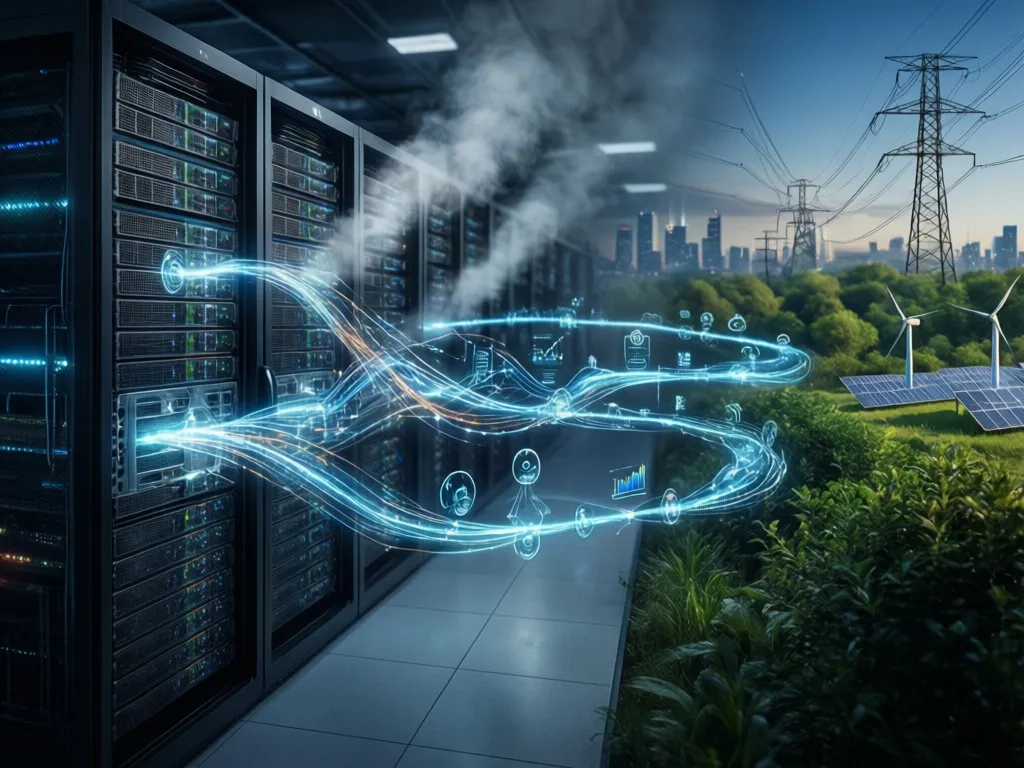
Where emissions appear across the ML lifecycle
Machine learning systems generate greenhouse gas emissions at multiple stages. Data collection and labeling require devices, storage and transport. Model development and training consume compute and electricity. Evaluation and hyperparameter search multiply compute needs through repeated experiments. Production inference and monitoring create steady operational electricity use. Beyond direct electricity, embodied emissions in hardware and software infrastructure, plus emissions from cloud and data center supply chains, matter for full accounting.
Data collection and labeling
Collecting raw data is often treated as costless from an emissions perspective but it can be material. Field sensors, client devices and data transfer all use energy. Human labeling or active learning workflows add travel, workstation time and paid crowd worker computing. Two practical ways to reduce climate impact at this stage are to design data needs deliberately and to prefer targeted labeling strategies over exhaustive annotation. Where possible, reuse existing high quality datasets and log the compute and transport steps used to create new datasets so those activities can be accounted for later.
Model training and its multipliers
Training is the stage most teams associate with high emissions because it typically uses many GPU or TPU hours. Emissions scale with compute time, hardware efficiency, datacenter power sourcing and how many experiments are run. Important drivers include model architecture, dataset size, choice of optimizer and the amount of hyperparameter search. A training workflow that repeats full experiments many times without early filtering multiplies emissions compared with a workflow that uses smaller proxies and staged validation.
Evaluation, hyperparameter tuning and repeated experiments
Evaluation includes validation runs, ablation studies and the experiment cycles that refine models. Many development cycles run dozens or hundreds of variants. That repetition is often the dominant source of emissions for research style work. To manage that, adopt staged evaluation where cheap proxies and lower fidelity tests filter ideas before committing to full scale runs, and capture metadata that lets you compare results without rerunning identical experiments.
Inference and ongoing operations
Once models are deployed, inference workloads often outlast training by years and can produce continuous emissions. Serving patterns matter here. High query rates with low batching efficiency or models deployed at many edge locations increase energy use. Monitoring, logging and real time feature computation also add to the operational footprint. For many applications inference emissions will exceed training emissions over the lifetime of the model, so planning for efficient deployment is essential.
How to measure emissions practically
Measurement starts with collecting reliable activity data. For compute heavy stages record instance types, CPU and GPU hours, utilization and the datacenter region. If available, capture electricity consumption directly from provider telemetry or on premise meters. Convert electricity to emissions using an agreed emission factor. Choose a consistent accounting method: location based factors reflect the grid where the compute ran, and market based factors reflect contractual procurement and energy attribute certificates. Document which method you use and why.
Key metadata to record for each significant run are the start and end times, the hardware profile including model and number of accelerators, average utilization where possible, and any additional services consumed such as storage or network intensive preprocessing. For evaluation campaigns, aggregate runs so the report shows the total compute consumed by the whole experiment rather than isolated best runs only.
Practical measurement steps
Step 1. Instrument orchestration and CI systems so job start and stop times and the instance types are logged automatically. Step 2. When provider telemetry exposes energy or carbon metrics use them, and reconcile provider reports with your own logged usage. Step 3. Choose an emission factor source and document whether you apply location or market based accounting. Step 4. Store all experiment metadata with the model lineage so you can trace emissions back to model artifacts.
Accounting choices and boundaries
Define system boundaries up front. Are you reporting only electricity used in training, or also embodied emissions from hardware manufacturing and data center construction? Are cloud provider shared infrastructure allocations included and if so how are they apportioned? Common pragmatic choices are to report direct electricity emissions and to provide an optional extended estimate that includes upstream embodied emissions. Be explicit about these decisions and present both the activity data and the conversion factors so readers can reproduce or update the calculations when better data is available.
Actions that reduce emissions without sacrificing model quality
Start with methodological changes that lower compute demand. Transfer learning and model fine tuning frequently deliver required quality with much less compute than training from scratch. Experiment design that stages evaluation from low to high fidelity prevents early waste. For hyperparameter search use bandit based or early stopping approaches that shut down poor trials quickly. Model compression methods like pruning, distillation and quantization reduce inference cost and can also speed training when applied correctly.
Infrastructure and scheduling choices also matter. Select more efficient accelerator types and recent generation hardware when it reduces wall clock time for the same training objective. Use instance sizing and autoscaling to avoid idle expensive accelerators. Where available, schedule non urgent training during periods when the local grid has lower carbon intensity or when the cloud provider reports lower marginal emissions. Choose providers, regions and datacenters with transparent energy procurement and the ability to report energy and carbon data.
Operational tactics that matter during deployment include caching frequent responses to avoid repeated compute, batching requests to increase utilization, and moving latency tolerant workloads to cheaper, more energy efficient instances or to the edge when that reduces end to end energy use. Monitor inference latency and utilization metrics alongside energy metrics so efficiency and user experience are balanced.
Decision criteria to choose mitigation options
When selecting interventions weigh three dimensions: expected emissions reduction, impact on model quality and development speed, and implementation cost. Low cost, low risk options include adopting transfer learning, adding early stopping, improving reproducibility to avoid repeat experiments, and instrumenting runs for measurement. Higher impact options that require more investment include refactoring data pipelines to avoid unnecessary preprocessing, switching to different hardware, or changing where you host workloads to take advantage of lower carbon electricity procurement. Prefer options that are measurable and reversible so you can verify gains without locking the team into a risky change.
Reporting and governance
Good reporting is granular, transparent and linked to model artifacts. For each model release provide the activity metrics, the emission factor and accounting method, and a short narrative of major contributors such as large hyperparameter sweeps or data collection campaigns. Track emissions per useful unit that make sense for your product, for example emissions per prediction or emissions per training objective achieved. Build review gates that require a published emissions summary before a large scale training run is approved.
When to consider hardware lifecycle and embodied emissions
If your organization runs data centers or owns hardware, include embodied emissions from manufacture and end of life in decision making for procurement and refresh cycles. Extending hardware lifetime through reuse, repair and efficient consolidation can lower lifecycle emissions per unit of compute delivered. When hardware procurement is vendor managed, ask for transparency about manufacturing and material sourcing so you can include those factors in longer term choices.
Common pitfalls and how to avoid them
Relying solely on coarse billing metrics hides important differences. Similar monetary cost can map to very different energy and carbon outcomes depending on region and workload shape. Ignoring the emissions of repeated experiments and failing to aggregate the total development footprint produces underestimates. Making optimization decisions that reduce compute at the cost of model performance without measuring the operational consequences shifts rather than reduces impact. Avoid these by instrumenting experiments early, aggregating across the entire project, and combining efficiency work with careful validation of user experience.
Teams that embed measurement and a simple emissions budget into their development lifecycle find it easier to choose lower impact paths without sacrificing product quality. Start small, record decisions, and iterate on measurement fidelity as you gain confidence and better data.