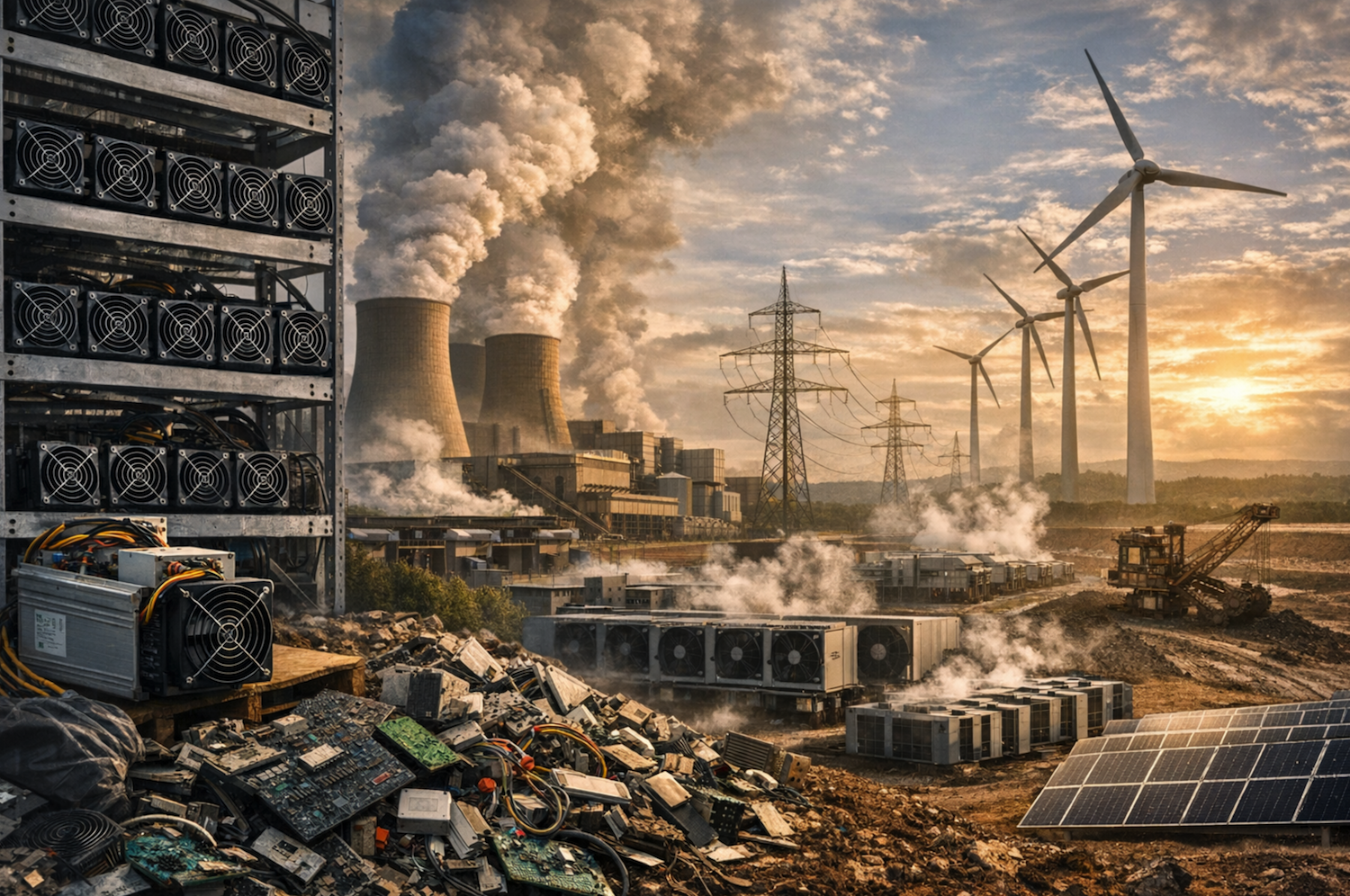
Distributed ledger systems and the tokens they secure have captured headlines, investment, and public imagination. Alongside financial and technical debates sits an environmental question that matters for regulators, developers, investors and communities: how much ecological harm does blockchain activity cause, and what can be done about it?
How blockchain operations translate into environmental impact
At the most basic level, the climate effect of a blockchain derives from the electricity its network consumes and the sources that produce that power. When a chain relies on energy-intensive processes to validate transactions, the systems total electricity demand rises. The resulting greenhouse gas output then depends on whether that electricity comes from low-carbon sources such as wind, solar or hydroelectricity, or from higher-carbon fuels like coal and gas.
But energy use is only the headline. Mining farms and specialized equipment produce electronic waste. The physical infrastructure supporting large installationscooling systems, land occupation and transmission lossesalso carries environmental costs. Evaluating the full footprint requires looking beyond kilowatt-hours to consider hardware lifecycles, local environmental stresses and the opportunity cost of the electricity consumed.
Why consensus mechanisms matter
Different blockchains secure their ledgers using distinct consensus methods, and those choices drive most differences in energy demand. Proof-of-work systems require participants to perform computationally intensive puzzles. These calculations are intentionally hard to make it costly to attack the network, and as a result they consume substantial power when widely adopted. Networks that use proof-of-stake, by contrast, assign validation rights based on the amount of native tokens staked by participants. Because staking does not require high-power computations, proof-of-stake networks operate with far lower electricity needs.
This distinction has real-world consequences. Some major public blockchains have migrated from proof-of-work to proof-of-stake to reduce energy consumption. Others, including several of the largest and most traded tokens, continue to rely on proof-of-work and therefore maintain high baseline energy use while the networks operate.
Beyond energy: e-waste and resource pressures
Crypto mining hardware is typically optimized for efficiency at a given algorithm. When that hardware becomes outdated or when the economics of mining shift, devices are frequently retired and replaced. The result is a stream of discarded electronics, often containing nontrivial quantities of metals and plastics that are costly to recycle. Unlike consumer electronics with longer upgrade cycles, mining rigs can become obsolete quickly because improvements in hardware performance and changes in network difficulty directly affect profitability.
Large mining operations also demand physical resources: robust cooling to keep equipment within safe operating temperatures, redundant power systems, and sometimes water for heat exchange. In regions where power supplies are already stressed, adding significant crypto-related electricity demand can increase local environmental risks, including greater air pollution from backup generators during outages and more wear on grid infrastructure.
Where miners locate and why grid mix matters
Because electricity costs are a major operational expense, miners often cluster in locations with cheap power. That has led to a complex geographic picture. In some places, low-cost electricity is available because of abundant renewable sources, and miners there may be able to claim a lower carbon intensity for their operations. In other regions, cheap power comes from fossil-fuel-heavy systems, which amplifies emissions.
Crucially, the environmental outcome depends on marginal rather than average electricity production. If miners use surplus renewable energy that would otherwise go unused, their incremental emissions footprint can be small. If they instead draw additional load from a grid that responds by firing up fossil generators, their activities increase greenhouse gas output. Tracking and proving the marginal impact at scale is technically and legally difficult, which complicates straightforward claims about how “green” a particular mining setup truly is.
Transaction-level accounting is misleading
Many public conversations reduce the environmental story to an energy-per-transaction figure. This approach can be misleading because it treats every transaction as incurring the full cost of network security. In proof-of-work chains, the total electricity used by the entire network secures all transactions, so per-transaction numbers depend heavily on network utilization and cannot capture dynamic security or economic interactions. In proof-of-stake systems, the link between a single transfer and marginal energy use is even weaker.
A more accurate way to think about impact is to consider how changes in transaction volumes, network upgrades, or shifts in consensus method alter the overall power profile. Layering and batching mechanisms that group many actions into a single on-chain settlement, for example, can reduce the energy burden attributed to a single transaction by spreading the cost across many operations.
Policy levers and market responses
Governments and industry bodies are experimenting with multiple instruments to reduce the environmental footprint of crypto. Some jurisdictions have tightened permitting or imposed restrictions on new mining capacity to protect local grids and reduce associated emissions. Others are exploring tax regimes or reporting obligations that encourage use of low-carbon electricity sources. Meanwhile, exchanges and institutional investors increasingly factor environmental considerations into underwriting and custody decisions, amplifying market pressure for cleaner operations.
At the technical and market level, services that provide “carbon-aware” validation or route transactions through energy-efficient layers are growing. Exchanges and custodians can add requirements for proof of clean energy sourcing, and financial institutions can refuse to provide services to miners that fail to meet environmental due diligence. These combined forcesregulatory, financial and technicalshift incentives toward lower-emission configurations.
Practical mitigation strategies for the industry
There are multiple practical approaches that projects and operators can adopt to reduce environmental impact. Moving consensus from computationally heavy models to energy-light alternatives is the most direct route for networks that can make the transition. For projects that must operate on existing proof-of-work chains, developers can minimize on-chain activity where feasible, using off-chain aggregation, rollups or other scaling solutions to reduce the number of transactions that require full network validation.
At the infrastructure level, operators can colocate with renewable generators or enter power purchase agreements that increase the supply of low-carbon electricity to the grid. Reusing waste heat from mining centers for local heating is a pragmatic way to capture some of the energy value that would otherwise be dissipated. Extending hardware lifetimes through refurbishment and resale programs reduces e-waste by keeping devices in use longer.
Transparency is also essential. Improved, verifiable reporting about power sources, marginal grid impacts, and equipment lifecycle practices helps investors and regulators distinguish meaningful improvements from superficial claims. Tools that combine electrical grid data, timestamps and proof-of-location can support more credible environmental statements.
Where blockchain can contribute positively
Despite environmental concerns, distributed ledger technology can play a role in climate solutions. Tokenization can improve transparency in carbon markets, enabling traceable registries and programmable credits. Decentralized identity systems can support robust verification of sustainability claims. Supply chain provenance solutions built on ledgers can reduce waste and improve resource efficiency. The environmental value of these applications depends on designing them with energy efficiency in mind and deploying them on networks that minimize incremental emissions.
Ultimately, the net climate impact of blockchain hinges on choices made by developers, miners, investors and regulators. Technical choices at the protocol layer set a baseline for energy demand. Operational decisions about hardware, site selection and electricity sourcing determine local environmental effects. Policy interventions and market signals can nudge the ecosystem toward lower-carbon behaviors, but credible change requires transparency, measurement and verified commitments rather than slogans.
For anyone involved with digital assetswhether as a developer, operator, investor or policymakerthe pragmatic starting point is careful measurement. Understand the energy intensity of the platforms you use, examine the electricity mix at the nodes that perform validation, and prefer architectures that minimize on-chain work or rely on low-energy consensus approaches. Combining technical redesign with better reporting and smarter procurement can reduce the ecological costs of an otherwise promising technology.