Why systematic carbon tracking matters now
Counting greenhouse gas emissions is no longer optional for many organizations. Investors, customers, regulators, and internal stakeholders expect transparent climate information that supports target-setting and performance monitoring. Carbon accounting software moves firms beyond spreadsheets by centralizing inputs, applying consistent methodologies, and producing auditable outputs that feed into strategy and disclosure.
Core capabilities of carbon accounting platforms
At a high level, these tools transform raw operational data into a verified emissions inventory. Key capabilities include data ingestion, emissions factor application, mapping to organizational and operational boundaries, analytics and scenario modeling, and reporting exports compatible with common disclosure frameworks. They also maintain an audit trail so every number can be traced back to source records and assumptions.
How data flows through a carbon accounting system
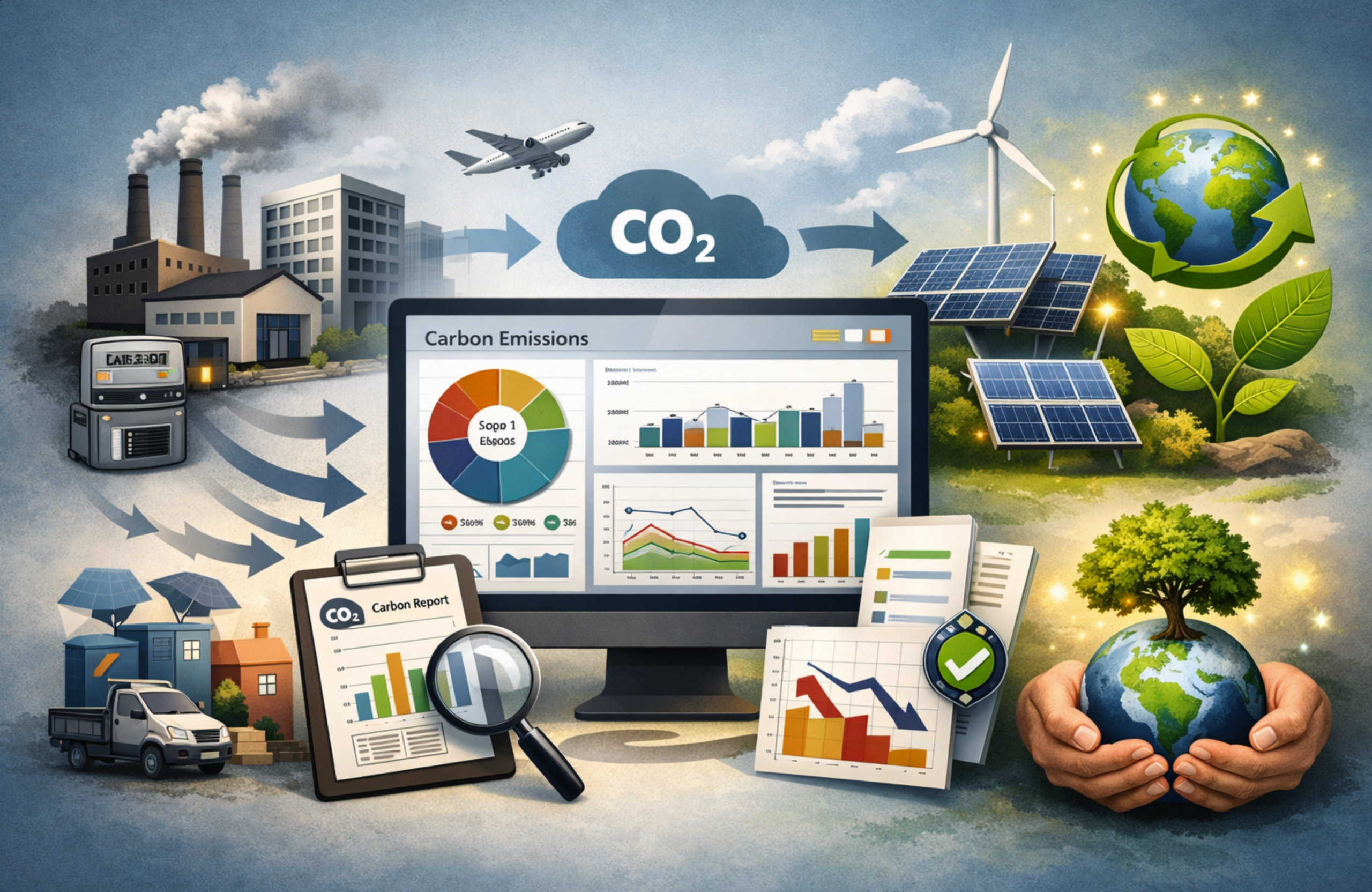
Data usually enters the system through a combination of automated connectors and manual uploads. Utility meters, building management systems, fleet telematics, travel booking platforms, procurement systems and cloud provider APIs are common sources. The platform standardizes diverse file formats and timestamps, aligns units, and timestamps transactions to ensure consistent time series.
Once ingested, the software assigns each datum to the appropriate emission category. That often means mapping to organizational boundaries such as operational control or equity share, and to activity categories aligned with reporting standards. The next step is the application of emissions factors: per-kWh electricity factors, fuel combustion coefficients, or supplier-specific factors for purchased goods. The product then aggregates results into Scope 1, Scope 2 and Scope 3 groupings when the business requires that categorization.
Standards and methodological anchors
Credible software aligns with recognized protocols to ensure consistency and comparability. The GHG Protocol is the most widely adopted framework for categorizing emissions and setting system boundaries. ISO 14064 provides specifications for quantifying and reporting greenhouse gas emissions. Disclosure platforms and frameworks such as CDP and the Task Force on Climate-related Financial Disclosures influence the shape of output templates and metrics that stakeholders expect. Many vendors build templates to produce the formats those platforms require.
Data quality, uncertainty and materiality
Good solutions expose data quality rather than hiding it. They attach provenance metadata to each input (source system, timestamp, whether meter-based or estimated) and quantify uncertainty where relevant. Materiality thinking helps teams focus effort: prioritizing the largest sources of emissions for higher-resolution measurement while using reasonable default factors for low-impact categories. Transparent documentation of assumptions reduces the risk of misinterpretation.
Integration patterns and technical architecture
Most modern carbon accounting tools operate as cloud-native services, offering APIs for two-way integration. Common architectural elements include data connectors, an ETL layer that cleans and normalizes inputs, a calculation engine that applies emission factors and rules, and a reporting layer that powers dashboards and exportable reports. Event-driven architectures can support near-real-time updates where meters or IoT sensors provide streaming data.
Enterprises often integrate these platforms with financial systems, procurement platforms and HR systems so emissions data can flow into budgeting, supplier assessments and employee travel reconciliations. Linking to ERP systems also enables reconciled cost and emissions tracking for lifecycle analyses and product-level footprinting.
Features that differentiate vendors
Vendors vary in their focus. Some emphasize comprehensive Scope 3 modules with supplier engagement workflows, while others specialize in operational emissions and renewable energy procurement management. Important differentiators to evaluate include the breadth of prebuilt connectors, the flexibility of the emissions factor library, scenario modeling capacity, support for assurance-ready exports, multi-entity consolidation, role-based access control, and localization for regional reporting requirements.
From inventory to action: analytics and decision support
Beyond measurement, the most useful tools help organizations prioritize and monitor reductions. This includes emissions hotspots analysis that surfaces high-impact suppliers or activities, marginal abatement cost curves, and forecasting modules that simulate the effect of interventions such as energy efficiency measures or fuel switching. Some platforms also track progress against corporate targets and integrate with project management systems so emissions reduction initiatives are monitored like other business projects.
Common implementation challenges
Implementations often stall for predictable reasons. Data fragmentation and legacy systems make automated extraction difficult. Procurement data can be incomplete or mismatched to spend records. Supplier engagement for Scope 3 requires time and incentives. Disagreements over boundary definitions or factor selection can create internal friction. Finally, organizations sometimes underestimate the need for ongoing governance: carbon accounting is not a one-off project but an evolving discipline that needs dedicated processes and ownership.
Practical steps to deploy an effective system
Start with a pilot that targets a high-impact business unit or emissions source. Use that pilot to validate data connectors, accelerate stakeholder buy-in and refine internal processes. Establish clear ownership for data collection and verification, and document calculation rules. Prioritize automation where it reduces manual effort and error. Design dashboards for different audiences: granular views for sustainability teams and summarized, decision-focused metrics for executives and finance.
Governance is essential. Define update cadences, reconciliation workflows and rules for handling estimates. Incorporate periodic external review or assurance to strengthen credibility, especially when disclosures inform investor decisions or regulatory compliance.
Avoiding common pitfalls
Do not let the pursuit of perfect data block progress. Reasonable, documented estimates are acceptable when made transparent and replaced with higher-quality data over time. Beware of double counting when consolidating across business units or value chain partners. Avoid over-reliance on offsets as a substitute for emissions reductions; offsets can be part of a strategy but should complement a clear plan to cut emissions directly.
Emerging trends and capabilities
Automation continues to accelerate. Increasingly sophisticated APIs from utilities and cloud providers enable faster ingestion. Machine learning assists with anomaly detection in meter readings and pattern-based supplier matching. Interoperability standards are maturing, making it easier to consolidate data from disparate systems. At the same time, regulatory developments and investor expectations are pushing for higher granularity and assurance, so platforms are adding support for audit trails and third-party verification workflows.
How to evaluate and choose a solution
Match the vendor’s strengths to your priorities. If your main challenge is Scope 3, choose a provider with supplier engagement tools and spend-to-emissions modeling. If operational emissions dominate, prioritize meter-level integrations and real-time analytics. Evaluate ease of integration, configurability of emissions factors and rules, quality of customer support, and the clarity of the audit trail. Ask for references from organizations with similar footprints and governance needs, and request a staged rollout plan that includes training for data stewards and periodic reviews.
Choosing the right platform is not just a technical decision; it is foundational to making informed climate choices across procurement, operations and finance. A good system turns fragmented data into a strategic asset that supports credible targets, better investment decisions and transparent reporting.